
How an Indian Freelancer Can Save More Than 50% on Taxes Using Section 44ADA
Section 44ADA lets eligible Indian freelancers pay tax on only 50% of their gross receipts — no books, no audit, no expense tracking. Here's how to actually use it.

Freelancer for 10+ years with clients in the USA, Australia, Europe, South Africa and India. Built InvoiceRocket to keep his own invoicing, GST and Section 44ADA tracking in order, and to give his CA everything in one place.
If you're an Indian freelance developer, designer, consultant, or other specified professional and you're not using Section 44ADA, you are almost certainly overpaying tax. This one section of the Income Tax Act was written specifically for people like us — and using it correctly can cut your tax bill roughly in half, legally, with less paperwork than a regular filing.
This is the guide I wish someone had handed me the day I went full-time freelance.
TL;DR. Section 44ADA lets eligible professionals — including software developers and IT consultants — declare 50% of gross receipts as profit and pay tax on that half only. No books, no audit, no expense tracking. Eligible up to ₹75 lakh in gross receipts (AY 2024-25 onwards) provided cash receipts are ≤5%. File ITR-4 (Sugam), declare 50%, and pay advance tax on schedule. On ₹24 lakh gross that is roughly ₹80,000 of tax instead of ₹2,90,000.
This is an explainer, not professional tax advice. Slabs, limits, and rules change every budget — confirm current numbers with a CA before you file.
What Section 44ADA actually does
Section 44ADA is a presumptive taxation scheme for specified professionals. In plain English: the government presumes that 50% of your gross professional receipts is profit, and the other 50% is business expenses. You pay tax only on the profit half. You don't need to prove the expense half. You don't need to track receipts. You don't need books of accounts. You don't need an audit.
It exists because the tax department knows that small professionals spend a lot of time and money doing bookkeeping that doesn't actually help anyone — least of all the tax department. 44ADA trades that complexity for a simple assumption, and the assumption is generous.
Who qualifies
You qualify for 44ADA if all of these are true:
- You are an individual, HUF, or partnership firm (not an LLP or company).
- Your profession falls under the specified list: legal, medical, engineering, architectural, accountancy, technical consultancy, interior decoration, or "any other profession notified" — which includes information technology, film artists, company secretaries, and authorised representatives.
- Your gross receipts for the year are within the threshold — ₹75 lakh as of AY 2024-25 onwards, provided cash receipts are ≤5% of the total (if you take mostly digital payments, which you should, you comfortably get the higher limit). Earlier, the limit was ₹50 lakh.
Most freelance software developers, UI/UX designers, product consultants, and technical writers fit squarely inside this.
How the "50% tax saving" actually works
Let's walk through a concrete example with a freelancer earning ₹24,00,000 (₹24 lakh) in gross receipts for the year, with no meaningful business expenses they want to track.
Without 44ADA
If they file under regular business income (ITR-3), they have to maintain books, track every expense, and pay tax on the net profit. Say they can legitimately claim ₹4 lakh in expenses — laptop, internet, co-working, phone. Taxable business income: ₹20 lakh.
Under the new tax regime (FY 2025-26 slabs, standard deduction not applicable to business income), tax on ₹20L works out to roughly:
- 0-3L: nil
- 3-7L: 5% = ₹20,000
- 7-10L: 10% = ₹30,000
- 10-12L: 15% = ₹30,000
- 12-15L: 20% = ₹60,000
- 15-20L: 30% = ₹1,50,000
- Total tax ≈ ₹2,90,000 (plus 4% cess)
With 44ADA
Declare 50% of gross receipts as deemed profit: ₹24L × 50% = ₹12 lakh taxable income. No expense tracking needed.
Tax on ₹12L under the new regime:
- 0-3L: nil
- 3-7L: 5% = ₹20,000
- 7-10L: 10% = ₹30,000
- 10-12L: 15% = ₹30,000
- Total tax ≈ ₹80,000 (plus 4% cess)
That's ₹2,10,000 less tax, paid on the exact same income. More than a 70% reduction in the tax bill, and you got your weekends back because you didn't spend them reconciling bank statements.
The "50% savings" in the title is the conservative framing — in practice, because presumptive profit also pushes you into lower slabs, the real savings often exceed that.
What you give up (and why it usually doesn't matter)
44ADA is not magic, and there are tradeoffs. None are serious for a typical freelancer:
- You can't claim actual expenses separately. The 50% is all-inclusive: laptop, rent, internet, software subscriptions — all already baked in.
- Depreciation is deemed claimed. If you ever leave 44ADA and sell business assets, the WDV is calculated as if you had claimed depreciation all along.
- You must declare at least 50% profit. Declaring less (e.g. you genuinely made only 30% profit in a bad year) is allowed, but it triggers mandatory books + audit — defeating the whole point.
- If you opt out, you can't opt back in for 5 years in some interpretations of 44AD. 44ADA itself is more flexible year-to-year, but check current rules with your CA.
For most freelancers, actual expenses come in well under 50% of receipts anyway. If your real expense ratio is 15–25%, 44ADA is straightforwardly a massive win.
Step-by-step: how to actually file under 44ADA
- Use ITR-4 (Sugam) — this is the form designed for presumptive income. Not ITR-3. One important exception: ITR-4 does not contain Schedule FA, so if you hold a foreign payment account (PayPal, Payoneer, Wise) you cannot use it — file ITR-3 and declare presumptive income there instead. You keep 44ADA either way; you only lose the simpler form. Non-disclosure carries a flat ₹10 lakh penalty, so don't file ITR-4 to avoid the schedule. Details in Schedule FA for Indian freelancers.
- Report gross receipts for the financial year. This should match what you've invoiced and collected. Keep your invoices organised — receipts are what matters, not invoices raised.
- Declare 50% (or more) as presumptive profit. If your actual net was higher, you can declare higher — but most freelancers declare exactly 50%.
- Pay advance tax in four instalments — 15% by 15 June, 45% by 15 September, 75% by 15 December, 100% by 15 March. Presumptive professionals can pay the full amount by 15 March in a single shot under Section 211, which is a nice cash-flow benefit.
- Choose the tax regime — new regime (default) or old regime. New is almost always better for freelancers under 44ADA because the deductions you lose (80C, HRA, etc.) are usually already exceeded by the 44ADA deemed-expense cushion.
- GST is separate. 44ADA is income tax only. If your turnover crosses ₹20 lakh (services), you need GST registration regardless.
Mistakes I see freelancers make
Forgetting the ₹75L threshold is for gross receipts, not profit. If you invoice ₹80 lakh and think "but my profit is only ₹40 lakh, I'm fine" — you're not. Cross the receipts threshold, lose 44ADA for that year.
Not separating professional from other income. 44ADA only covers professional income. If you have salary, rental, or capital gains on the side, those are taxed separately in the same return. Don't blur them.
Treating 44ADA as permission to not keep records. The tax department can still scrutinise your receipts. Keep bank statements, invoice copies, and FIRC certificates (for international payments) for at least 6 years. You don't need books — you do need records.
Missing advance tax. Presumptive filers are not exempt from advance tax. Interest under 234B/234C kicks in if you don't pay it on schedule. If you only remember to pay by 15 March, make sure you pay the full year's liability by then.
Ignoring foreign income rules. If you're exporting services, receipts are still your gross — in INR, at the conversion rate on the date of receipt. 44ADA applies to the INR amount.
A small worked example for export freelancers
You're invoicing a US client $5,000/month. Over the year, that's $60,000 — say ₹50 lakh at prevailing rates. You're well under the ₹75L ceiling. You file ITR-4, declare ₹25L as presumptive profit, pay tax on that, and you're done. No books, no audit, no expense tracking. GST is a separate filing (LUT to avoid IGST on exports — covered in our other post).
Should you always use 44ADA?
Two situations where you might not want to:
- High actual expenses. If you're running a real setup with employees, office rent, and capex that together exceed 50% of receipts — normal business filing under ITR-3 will give you a lower tax bill. Rare for solo freelancers.
- You want to claim business losses. Under 44ADA you can't carry forward losses because you're not declaring actual profit/loss. If you had a genuinely loss-making year and want to set it off against future years, skip 44ADA.
For 95% of freelance developers working solo — 44ADA wins.
The habit that makes 44ADA effortless
The only ongoing discipline 44ADA requires is knowing your gross receipts at any point in the year. Not invoices raised — receipts collected. That's what the threshold and the 50% calculation are based on.
Good invoicing software tracks this automatically. Every time a payment is marked received, your "receipts to date" number updates. You know if you're approaching the ₹75L ceiling. You know what your advance-tax instalment should be. You know what your year-end 44ADA profit will look like.
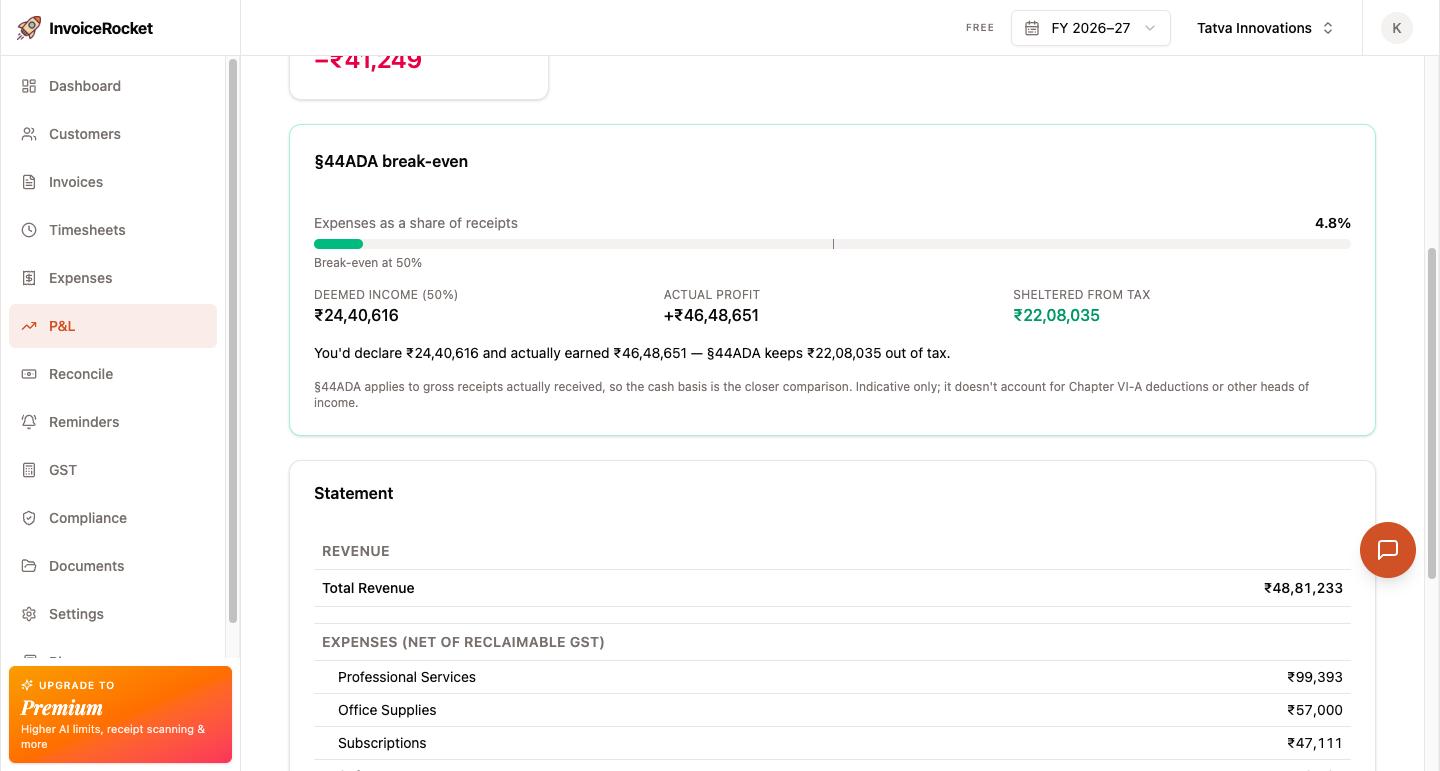
If you want that built in, InvoiceRocket is designed specifically for Indian freelancers: it tracks gross receipts, separates GST from your professional income, handles LUT-based exports, and gives you the one number you need at tax time. It's free for most freelancers.
Whether you use a tool or a spreadsheet — the goal is the same: know your receipts, file ITR-4, declare 50%, pay tax on half your income instead of all of it. That's the gift Section 44ADA hands every eligible Indian freelancer. It's on you to unwrap it.
Frequently asked questions
Who qualifies for Section 44ADA?
You need all three: you're an individual, HUF, or partnership firm (not an LLP or company); your profession is on the specified list (legal, medical, engineering, architectural, accountancy, technical consultancy, interior decoration, or a notified profession — which includes information technology); and your gross receipts for the year are within ₹75 lakh as of AY 2024-25 onwards, provided cash receipts are 5% or less of the total. The earlier limit was ₹50 lakh.
Which ITR form do I use for Section 44ADA?
ITR-4 (Sugam) — the form designed for presumptive income. Not ITR-3.
Is the ₹75 lakh limit on gross receipts or on profit?
Gross receipts, not profit. If you invoice ₹80 lakh and your actual profit is ₹40 lakh, you have still crossed the threshold and lose 44ADA for that year. This is the most expensive misreading of the section.
Do I still need to pay advance tax under 44ADA?
Yes. Presumptive filers are not exempt, and interest under 234B/234C applies if you don't pay on schedule. The concession is that presumptive professionals can pay the full year's liability in a single instalment by 15 March under Section 211, rather than across four quarterly dates.
Can I claim business expenses separately under 44ADA?
No. The 50% deemed expense is all-inclusive — laptop, rent, internet, software subscriptions are already baked into it. Depreciation is also treated as deemed claimed, so if you later leave 44ADA and sell business assets, the written-down value is computed as if you had claimed depreciation throughout.
Does Section 44ADA cover GST as well?
No. 44ADA is income tax only. If your turnover crosses ₹20 lakh for services, you need GST registration regardless of how you file your income tax return.
How does 44ADA work if my clients are overseas?
Your receipts are still gross receipts, counted in INR at the conversion rate on the date of receipt. 44ADA applies to that INR amount exactly as it would to domestic income.
When should I not use 44ADA?
Two cases. If your genuine expenses exceed 50% of receipts — employees, office rent, real capex — regular filing under ITR-3 produces a lower bill. And if you had a loss-making year and want to carry the loss forward against future years, 44ADA can't do that, because you're not declaring actual profit or loss.