
FTE vs Freelancer in India: The ₹7.5 Lakh 'Freelance Premium' on a ₹50L Income
On the same ₹50 lakh gross income, an Indian freelancer keeps roughly ₹7.5 lakh more than a full-time employee. Here's the math behind the freelance premium — and what it costs you in documentation discipline.

Freelancer for 10+ years with clients in the USA, Australia, Europe, South Africa and India. Built InvoiceRocket to keep his own invoicing, GST and Section 44ADA tracking in order, and to give his CA everything in one place.
In 2026, the tax gap between an Indian salaried employee and a self-employed professional is wider than it has ever been. If you're earning ₹50 lakh a year, the single biggest factor determining how much of it you actually keep is how that income is categorised — salary or professional receipts.
Same number on the offer letter. Two very different outcomes after tax.
TL;DR. On the same ₹50 lakh gross income, an Indian freelancer under Section 44ADA keeps roughly ₹7.5 lakh more than a salaried employee — about ₹45.4 lakh take-home versus ₹37.9 lakh — because 44ADA deems 50% of receipts to be expenses while an employee gets only a ₹75,000 standard deduction. GST input tax credit widens the gap further. The premium is conditional on clean records: gross-receipts tracking, GST reconciliation, and advance tax paid on schedule.
This is an explainer, not professional tax advice. Slabs and rules change every budget — confirm current numbers with a CA before you file.
The headline comparison
A side-by-side at ₹50,00,000 gross annual income:
| Full-Time Employee | Freelancer (Section 44ADA) | |
|---|---|---|
| Gross income | ₹50,00,000 | ₹50,00,000 |
| Deemed expenses | Nil (only ₹75k standard deduction) | ₹25,00,000 (50% flat) |
| Taxable income | ₹49,25,000 | ₹25,00,000 |
| Estimated tax | ~₹12,14,200 | ~₹4,57,600 |
| Take-home (post-tax) | ~₹37,85,800 | ~₹45,42,400 |
The result: the freelancer keeps ₹7.5 lakh+ more on the exact same ₹50 lakh — without working a single extra hour or charging a rupee more.
That gap is what I call the freelance premium.
Why it works: three legal levers
This isn't a loophole — it's the income tax act doing exactly what it was designed to do. Three distinct mechanisms stack on each other.
1. Section 44ADA — Presumptive taxation
Eligible professionals (software developers, designers, technical consultants, CAs, doctors, lawyers, and a few others on the specified list) can declare 50% of gross receipts as profit under Section 44ADA. The other half is deemed to be business expenses — no receipts, no books, no audit required. You're taxed only on the profit half.
For ₹50L gross, that's ₹25L taxable. Done.
A salaried employee gets none of this. The only equivalent is a ₹75,000 standard deduction.
For a deeper walkthrough of who qualifies and how to file, see How an Indian Freelancer Can Save More Than 50% on Taxes Using Section 44ADA.
2. Real business deductions when you need them
If your actual expenses are unusually high — say you've hired help, taken an office, or made significant capex — you can skip 44ADA and file regular books (ITR-3), deducting actual business expenses before arriving at taxable income.
Most solo freelancers do better on 44ADA because the 50% deemed expense is comfortably above their real spending. But the option exists. An employee has neither — they cannot deduct the laptop they bought to do their job.
3. GST input tax credit
Once your turnover crosses ₹20 lakh in services, GST registration is mandatory. The upside: every rupee of GST you pay on business inputs — gadgets, professional services, software — comes back to you as input tax credit, reducing the GST you owe on your invoices.
For an employee, the 18% GST on a new MacBook is just a cost. For a registered freelancer, it's recoverable.
The catch: documentation discipline
Here's the part most "go freelance!" content skips. Every benefit above is conditional on clean, audit-ready records:
- 44ADA still requires you to know your gross receipts. If you cross the ₹75 lakh ceiling without realising, the whole scheme falls away that year.
- GST audits in 2026 are data-driven. The department reconciles your GSTR-1, GSTR-3B, and your customers' GSTR-2B automatically. A wrong HSN code, a missing place-of-supply, or a number that doesn't match the buyer's filing will surface a notice within weeks, not years.
- ITC claims need invoices that match. If your vendor doesn't file their GSTR-1 correctly, your input credit gets blocked — and you have to chase them.
- Advance tax kicks in for any liability above ₹10,000, and 44ADA doesn't exempt you. Miss the schedule and 234B/234C interest eats into the savings.
This is where most freelancers quietly lose the premium they thought they were earning. The tax bill is fine; the friction tax of bad documentation is what hurts — late nights before filing, missing receipts, GST notices, unreconciled bank statements.
What an "Office of One" actually looks like
If you're running solo and want to keep that ₹7.5 lakh, the documentation stack you need is shorter than people assume:
- One source of truth for invoices — sequential numbering, GSTIN on both sides, HSN codes, place of supply, due dates. No spreadsheets, no Word docs, no manually-formatted PDFs.
- Receipts tracked separately from invoices raised — 44ADA's threshold is on receipts collected, not invoices issued.
- Expenses with the underlying receipt attached — even if you file 44ADA and don't claim them on income tax, they matter for GST ITC.
- Timesheets for billable hours, especially if you bill hourly or need to defend your scope to a client (or your CA).
- GST-ready exports: GSTR-1 JSON, expense ledgers, FIRC tracking for international receipts.
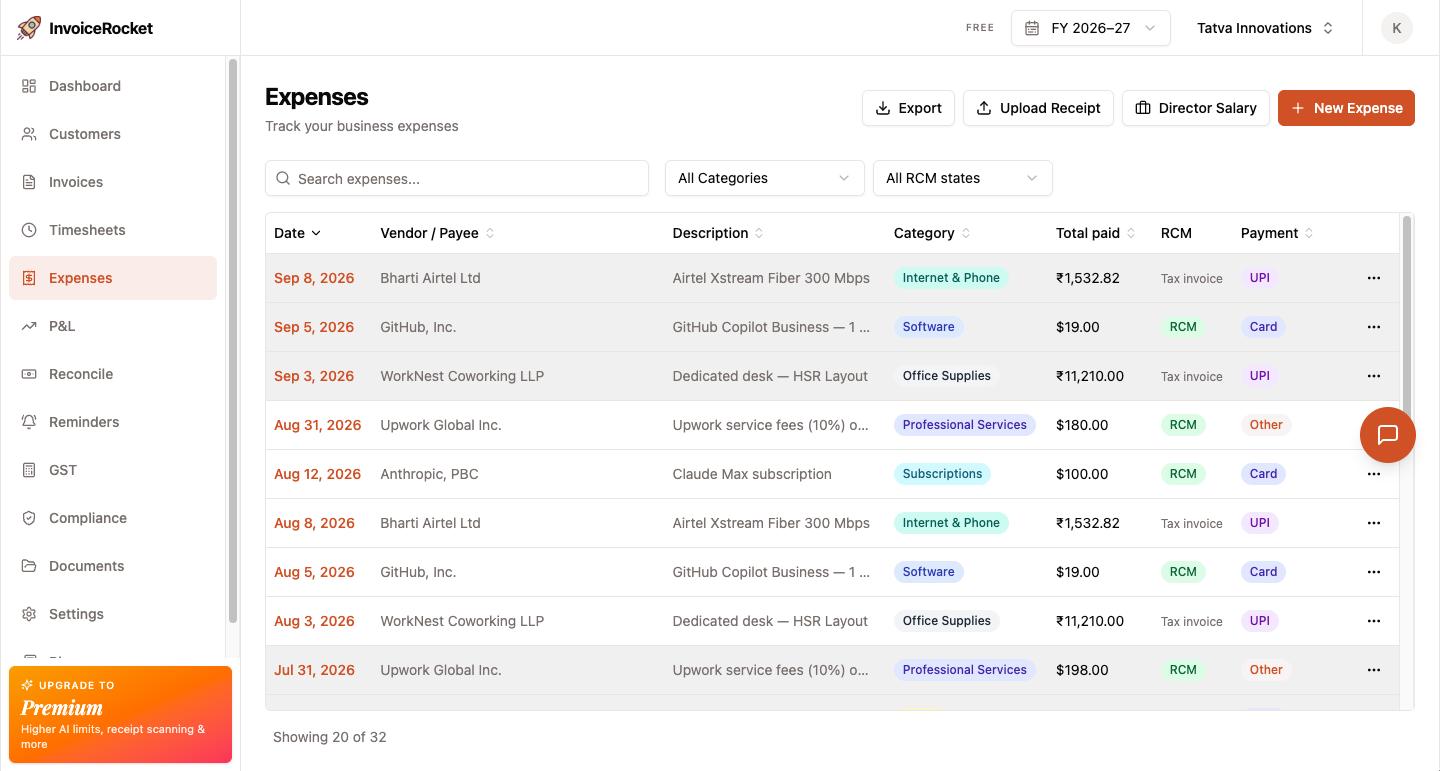
If you have all five, annual filing is a one-evening job. If you don't, it's the reason you'll spend a long weekend in March wondering why you went freelance in the first place.
So — are you actually claiming the premium?
The decision isn't really "FTE vs freelancer" — it's "do I want to be an employee, or do I want to run a one-person business?" The income tax act treats those very differently, and in 2026 it has never rewarded the second one more.
The catch is the boring one: bookkeeping. The ₹7.5 lakh the law lets you keep is conditional on you not handing it back through penalties, missed ITC, and weekends spent firefighting documentation.
I built InvoiceRocket as the office-of-one stack I wanted for myself — invoices, GST, timesheets, expenses, and audit-ready exports in one place. It's free for most freelancers, and the point of it is precisely so you can spend the freelance premium on things you actually care about, not on a CA's "urgent reconciliation" call in March.
Whatever tool you use, the question is the same: are you staying salaried for the perceived security, or is it time to claim the premium that's been sitting on the table the whole time? 🚀
Frequently asked questions
How much more does a freelancer keep than an employee on ₹50 lakh?
Roughly ₹7.5 lakh more on identical gross income. The employee's taxable income is ₹49,25,000 after only the ₹75,000 standard deduction, giving tax of about ₹12,14,200 and take-home near ₹37,85,800. The freelancer under Section 44ADA declares ₹25,00,000 taxable, pays about ₹4,57,600, and takes home around ₹45,42,400.
Why is the gap so large?
Three legal mechanisms stack. Section 44ADA lets eligible professionals declare 50% of gross receipts as profit, with the other half deemed expenses — no receipts, books, or audit. Real business deductions remain available if your actual expenses exceed 50%, by filing ITR-3 instead. And GST input tax credit makes the 18% GST on business purchases recoverable rather than a sunk cost.
Can a salaried employee deduct work expenses?
No. The only equivalent is the ₹75,000 standard deduction. An employee cannot deduct the laptop they bought to do their job, and the 18% GST on it is simply a cost.
What's the catch with the freelance premium?
Documentation discipline. Every benefit is conditional on audit-ready records: knowing your gross receipts so you don't cross the ₹75 lakh 44ADA ceiling unnoticed, surviving data-driven GST reconciliation across GSTR-1, GSTR-3B and your customers' GSTR-2B, keeping ITC claims that match your vendors' filings, and paying advance tax on schedule to avoid 234B/234C interest. Most freelancers lose the premium not to tax but to the friction of bad documentation.
Does GST registration help or hurt a freelancer?
It's mandatory once services turnover crosses ₹20 lakh, and on balance it helps. Every rupee of GST you pay on business inputs — gadgets, professional services, software — comes back as input tax credit, reducing what you owe on your own invoices.
What records do I actually need to keep the premium?
Five things: one source of truth for invoices with sequential numbering, GSTIN on both sides, HSN codes, place of supply and due dates; receipts tracked separately from invoices raised, since 44ADA's threshold is on receipts collected; expenses with the underlying receipt attached, which matter for GST ITC even if you don't claim them on income tax; timesheets for billable hours; and GST-ready exports including GSTR-1 JSON and FIRC tracking for international receipts.