
How to File LUT for Export of Services as a Freelance Developer in India
If you invoice foreign clients in foreign currency, LUT is the difference between keeping 100% of every invoice and locking up 18% in a GST refund queue for six months. Here's how to file it correctly — and the mistakes that quietly cost freelancers the most.

Freelancer for 10+ years with clients in the USA, Australia, Europe, South Africa and India. Built InvoiceRocket to keep his own invoicing, GST and Section 44ADA tracking in order, and to give his CA everything in one place.
If you're an Indian freelancer with US, UK, EU, or other non-Indian clients, and you're GST-registered, LUT is the single piece of paperwork that decides whether you keep 100% of every invoice or quietly hand over 18% of it to the GST department for six to nine months.
Most freelancers I talk to either don't know LUT exists, file it once and forget to renew it, or charge IGST on exports "to be safe" — which is the most expensive form of safety in tax.
This is the practical guide.
TL;DR. LUT (Form GST RFD-11) lets you invoice foreign clients without charging 18% IGST. File it free on the GST portal in about ten minutes — Services → User Services → Furnish Letter of Undertaking — valid for one financial year, renewed every April with no auto-renewal. Put the declaration line and ARN on every export invoice, and receive the foreign currency within 1 year or you owe IGST retroactively with interest. FEMA now allows 15 months, but the GST year is the deadline that bites.
This is an explainer, not professional tax advice. GST rules and forms change — confirm current procedures on the GST portal or with your CA before filing.
Why LUT exists (and why you can't skip it)
When you export services from India, the law treats it as a zero-rated supply under Section 16 of the IGST Act. Zero-rated, not exempt — important distinction. The government wants exports to leave the country GST-free, but it gives you two ways to make that happen:
- Pay IGST (18%) on the export invoice, then file a refund claim to get it back from the GST department. Refunds typically take 60–180 days. During that window, your cash sits with the government.
- File a Letter of Undertaking (LUT) once a year, then export without charging IGST at all. No cash blocked, no refund claim, no follow-up.
For a freelancer invoicing $5,000/month, option 1 means roughly ₹75,000–90,000 of cash is locked up at any given time. Option 2 means zero. That's the entire game.
LUT is the form (technically GST RFD-11) that tells the department: "I'm an exporter in good standing. Let me invoice without IGST. If I fail to bring the foreign currency in within the prescribed time, I'll pay the IGST then."
Who can file LUT
Almost every freelance exporter qualifies. The rules:
- You must be GST-registered.
- You must not have been prosecuted for tax evasion of ₹2.5 crore or more. (For solo freelancers, effectively never relevant.)
- You must be exporting goods or services, or supplying to an SEZ.
That's it. There's no minimum turnover, no minimum export volume, no DSC requirement (EVC works fine for individuals).
If you're not GST-registered yet but cross ₹20 lakh in services turnover, registration is mandatory anyway — and the day you register, file LUT in the same week.
What counts as "export of services" under GST
A supply qualifies as export of services only if all five conditions in Section 2(6) of the IGST Act are met:
- Supplier in India (you).
- Recipient outside India.
- Place of supply outside India. For most services this is the recipient's location — but check OIDAR rules if you're selling SaaS or downloadable products.
- Payment received in convertible foreign exchange (USD, EUR, GBP, etc.) or in INR through an RBI-permitted Vostro account.
- Supplier and recipient are not merely establishments of the same legal entity.
Most freelancers tick all five comfortably. The one that trips people up is point 4. If your US client pays you via an Indian fintech that converts USD to INR before crediting your account, that's still foreign exchange — but your bank credit advice or FIRC must show the foreign currency leg, not just the INR landing. Keep those documents.
How to file LUT — step by step
Filing takes about ten minutes once a year. The exact sequence:
- Login to the GST portal (gst.gov.in) with your GSTIN credentials.
- Navigate to Services → User Services → Furnish Letter of Undertaking (LUT).
- Select the financial year for which you're filing. LUT is valid for one FY — file for FY 2026-27 in April 2026.
- If you've filed before, upload the previous LUT acknowledgement (optional, but advised).
- Tick the three self-declarations about meeting export conditions, foreign currency receipt within the prescribed time, and acknowledging IGST liability if conditions aren't met.
- Enter details of two independent witnesses — name, occupation, and address. A friend or fellow freelancer is fine. They don't sign anything; you just list them.
- Sign with DSC or EVC. EVC = OTP to your registered mobile and email. Done.
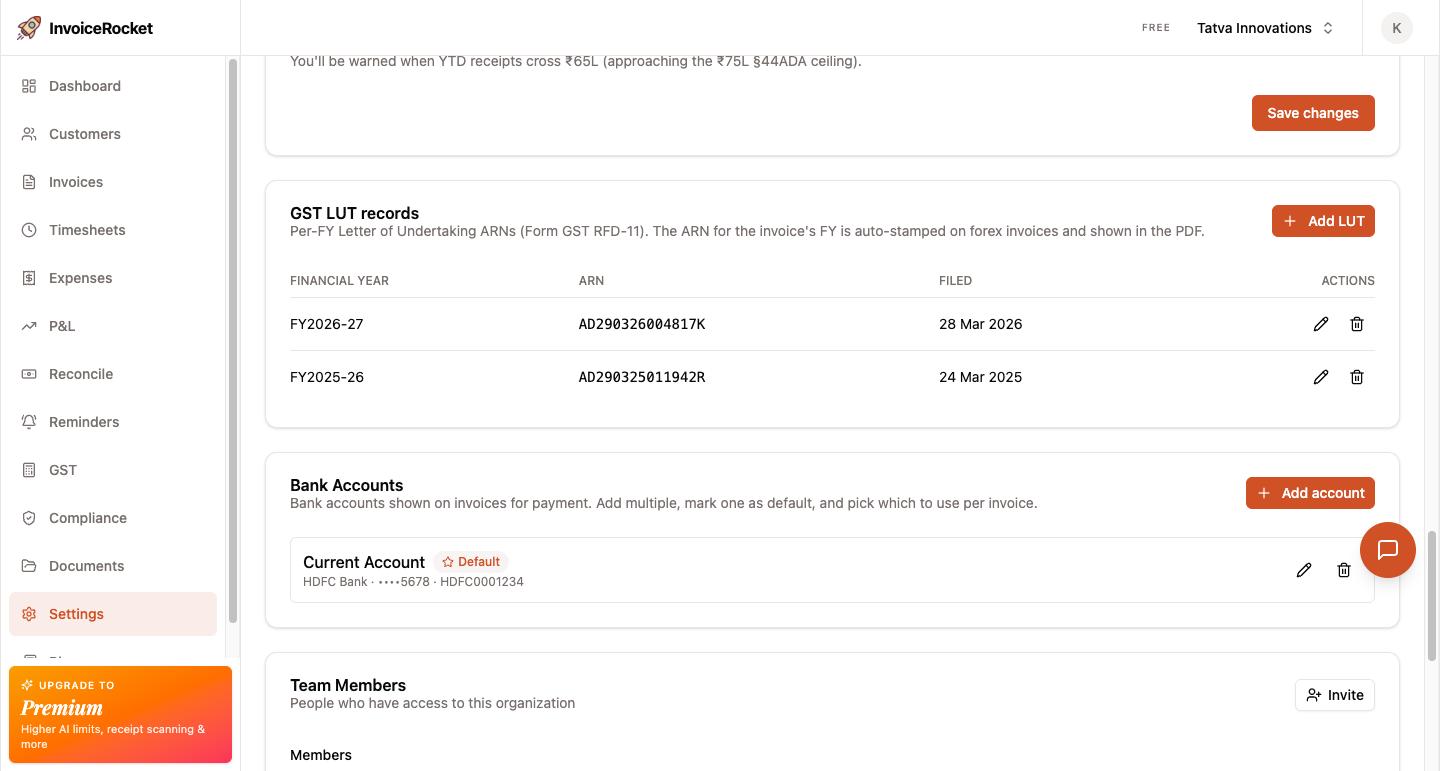
- Download the acknowledgement (ARN). Save it. You'll reference it on every export invoice.
That's the entire process. The portal does not charge a fee.
When to file (and what to do if you forget)
LUT is valid for a single financial year — 1 April to 31 March. File before you raise your first export invoice of the FY. The cleanest cadence is to file in the first week of April every year and put a recurring reminder on your calendar.
If your LUT expires and you keep invoicing without IGST, you have two cleanup paths:
- File LUT now and continue. The fresh LUT covers invoices from its filing date onward. Invoices raised in the gap are technically irregular — you should pay IGST on those and claim refund. Annoying, but recoverable.
- Pay IGST on the gap invoices voluntarily when you discover the lapse, then file RFD-01 to claim it back. You'll get the money in 60–180 days.
Either way, do not pretend the gap didn't happen. GST scrutiny compares LUT filing date against export invoice date — mismatches are easy to spot and harder to explain after the fact.
What to put on the export invoice itself
Just need one export invoice right now? Use our free GST invoice generator — toggle Export under LUT and every field below is pre-filled correctly.
Once LUT is filed, your export invoice should clearly show:
- "Supply meant for export of services under LUT without payment of integrated tax" as a declaration line
- LUT ARN number and date
- Recipient legal name, address, and country (no Indian GSTIN — they don't have one)
- Currency and amount in the foreign currency, not INR
- No IGST line — tax columns show ₹0 / not applicable
- HSN/SAC code (998314 covers most software / IT consulting services)
- Place of supply marked as the recipient's country with country code
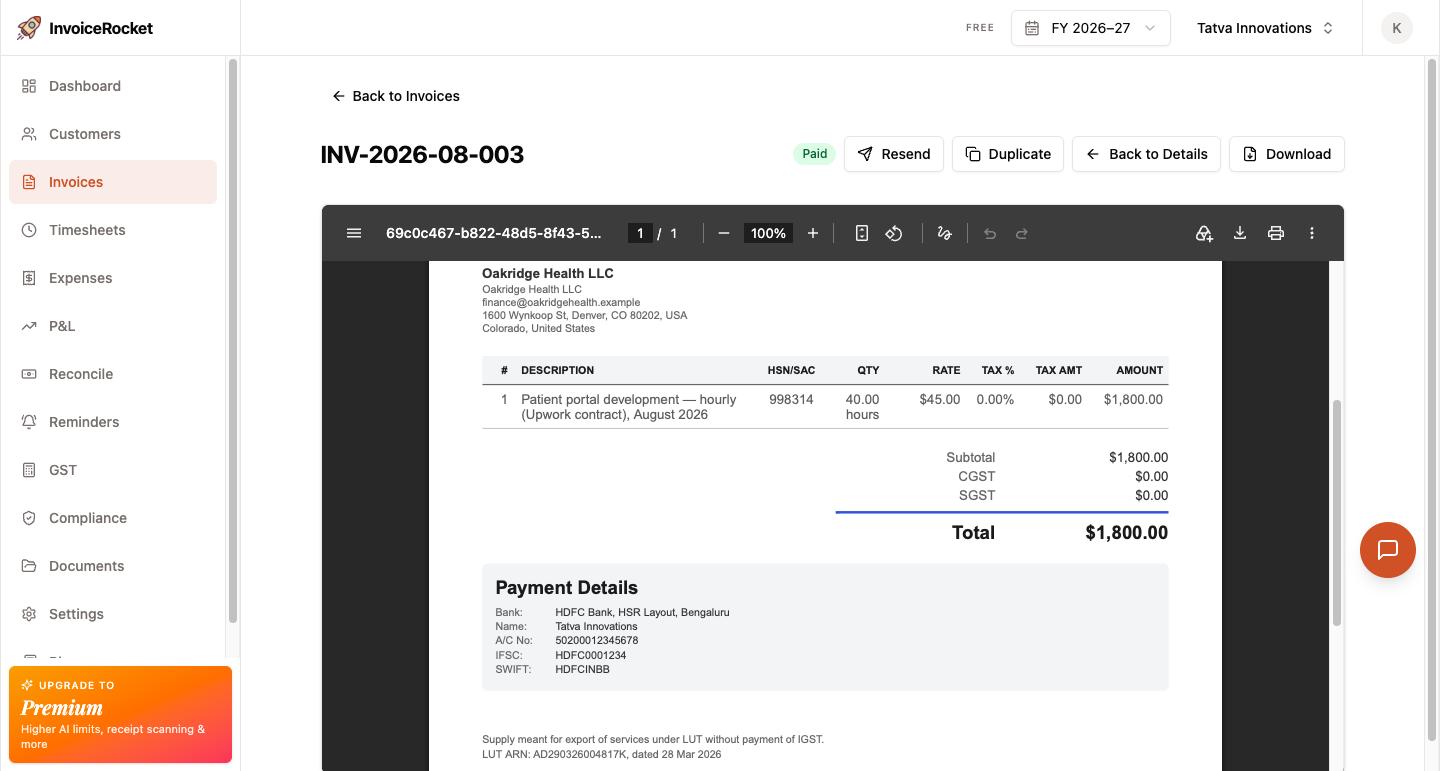
If your invoicing tool doesn't support these fields out of the box, you'll forget one on a Friday afternoon — and that's exactly the kind of thing GST scrutiny notices latch onto.
The 1-year realisation rule
Here is the LUT rule that quietly catches the most freelancers:
You must receive the foreign currency payment within 1 year from the date of the export invoice. If you don't, you owe IGST on that invoice — retroactively, with interest under Section 50.
FEMA used to be stricter, at 9 months. For invoices dated from 1 October 2026, RBI allows 15 months for foreign-currency invoices, and your bank tracks each one through the monthly EDF you now file. That doesn't extend the GST deadline, so treat one year as your real ceiling.
For most freelancers this is a non-issue because clients pay within 30–60 days. But if you have a client dragging their feet — see our playbook on getting paid on time — the LUT clock is one more reason not to let an invoice slide past six months.
If a payment is genuinely never going to land, write the invoice off and pay IGST + interest on it. Don't pretend it's still pending past the 1-year mark.
Mistakes I see freelancers make
Charging IGST "to be safe" on exports. This isn't safe — it's expensive. Once you charge IGST, your client either disputes it (foreign clients shouldn't be paying Indian GST), or you absorb it and chase a refund for months. File LUT instead. It's free.
Forgetting to renew on 1 April. Set a recurring calendar event titled "File LUT for FY [year]" on April 1 every year. Your invoicing software should also be tracking this in the background.
Skipping the LUT declaration on the invoice. Even with a valid LUT, an export invoice that doesn't carry the declaration line and ARN looks indistinguishable from a domestic invoice. AP teams and auditors both get confused. Always include both.
Not collecting FIRC / bank credit advice. When the GST officer asks for proof that you actually received foreign currency, your bank's FIRC (Foreign Inward Remittance Certificate) is the document. Most banks now issue an "e-FIRC" automatically — log into your bank portal and download it for every export receipt. File them with the corresponding invoice.
Treating LUT as "filed once, forever". It isn't. Each FY needs its own LUT. There is no auto-renewal.
Mixing domestic and export invoices in the same series. Not technically illegal, but it makes reconciliation painful and increases the chance of an export invoice accidentally getting IGST applied. Use a separate prefix for export invoices (e.g. INV-EXP/2026-27/001).
How LUT fits with the rest of your tax setup
LUT is GST-only. It does not affect:
- Income tax — your gross receipts, converted to INR at the rate on the date of receipt, are still your gross receipts. Section 44ADA applies the same way.
- Advance tax — pay on schedule regardless.
- TDS — your Indian clients deduct TDS; foreign clients generally don't.
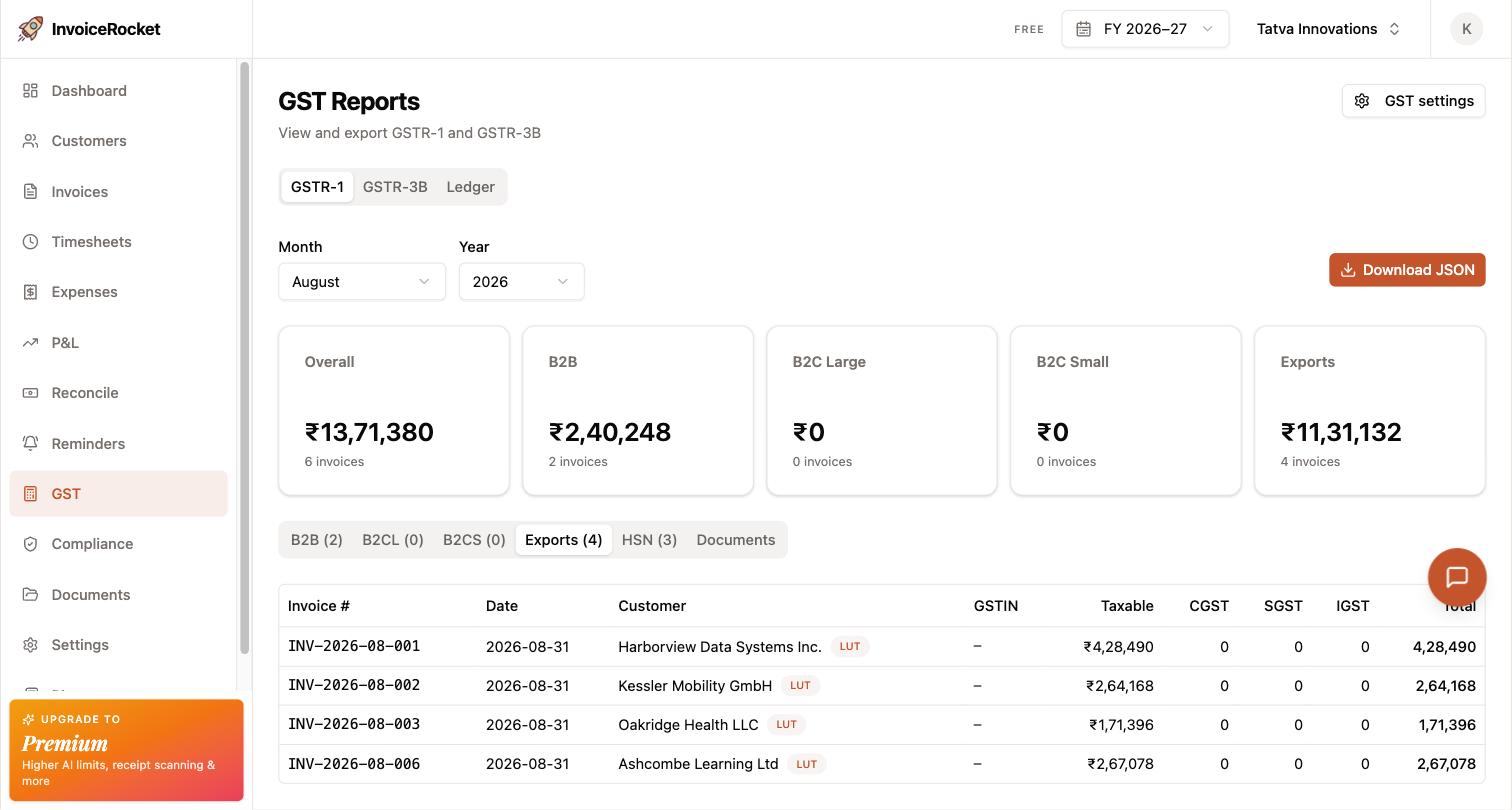
What LUT changes is: on your GSTR-1, export invoices show as zero-rated supplies under LUT in the dedicated table for export invoices. Your output tax liability stays low, and there's no refund claim queue piling up. Make sure your invoicing tool fills that table correctly when you export the GSTR-1 JSON.
The one habit that makes LUT effortless
Two reminders on your calendar:
- April 1 every year — file LUT for the new FY.
- The 1st of every month — reconcile last month's export receipts against the FIRCs / bank credit advices.
That's it. Everything else flows from those two habits.
Good invoicing software handles most of this for you: prefills the LUT declaration on export invoices, keeps exports and domestic invoices in one continuous serial, flags export proceeds that haven't been evidenced by a FIRA, and reminds you when LUT renewal is due.
If you want that built in, InvoiceRocket is designed specifically for Indian freelancers exporting services — LUT-aware export invoices, FIRC tracking, one continuous invoice serial across domestic and export work, and reminders for both LUT renewal and the realisation window. It's free for most freelancers.
The unsexy truth about LUT is that it's a five-minute filing that protects roughly two months of your annual revenue from getting locked up in a refund queue. Few pieces of compliance pay back that quickly. File yours this week.
Frequently asked questions
What is an LUT and why do I need one?
A Letter of Undertaking (Form GST RFD-11) lets you invoice export clients without charging 18% IGST. Exports are zero-rated under Section 16 of the IGST Act, and you get there one of two ways: charge IGST and claim a refund 60–180 days later, or file an LUT once a year and never charge it. For a freelancer invoicing $5,000/month, the first option locks up roughly ₹75,000–90,000 in cash at any moment. The second locks up nothing.
Who can file an LUT?
Almost every freelance exporter. You must be GST-registered, must not have been prosecuted for tax evasion of ₹2.5 crore or more, and must be exporting goods or services or supplying an SEZ. There's no minimum turnover, no minimum export volume, and no DSC requirement — EVC works fine for individuals.
How do I file an LUT?
On the GST portal, go to Services → User Services → Furnish Letter of Undertaking (LUT), select the financial year, optionally upload your previous acknowledgement, tick the three self-declarations, enter two independent witnesses (name, occupation, address — they don't sign anything), and sign with DSC or EVC. Download the ARN acknowledgement and keep it, since you reference it on every export invoice. It takes about ten minutes and the portal charges no fee.
How long is an LUT valid?
One financial year, 1 April to 31 March. There is no auto-renewal — each FY needs its own LUT. File in the first week of April, before you raise your first export invoice of the year.
What happens if my LUT expires and I keep invoicing?
Two cleanup paths. File a fresh LUT now, which covers invoices from its filing date onward, and pay IGST plus claim refund on the gap invoices. Or voluntarily pay IGST on the gap invoices when you spot the lapse and file RFD-01 to claim it back in 60–180 days. Don't ignore it — GST scrutiny compares your LUT filing date against export invoice dates, and the mismatch is easy to spot.
What must my export invoice show under LUT?
The declaration "Supply meant for export of services under LUT without payment of integrated tax", your LUT ARN number and date, the recipient's legal name, address and country (no Indian GSTIN), the amount in foreign currency, no IGST line with tax columns at zero, the HSN/SAC code (998314 covers most software and IT consulting), and place of supply marked as the recipient's country.
How long do I have to receive the foreign payment?
One year from the invoice date — miss it and you owe IGST on that invoice retroactively, with interest under Section 50. RBI's FEMA window is now 15 months for invoices from 1 October 2026 (it was 9), but that doesn't extend the GST deadline, so treat one year as the real ceiling.
Should I charge IGST on exports just to be safe?
No — that's the most expensive form of safety in tax. Your foreign client shouldn't be paying Indian GST and may dispute it, or you absorb the 18% and chase a refund for months. Filing the LUT is free and takes ten minutes.