
GSTR-1 and GSTR-3B: The Indian Freelancer's Monthly GST Filing Checklist
Two returns, two due dates, one annual headache — unless you understand what each form actually does. A freelancer-focused walkthrough of GSTR-1, GSTR-3B, the QRMP scheme, and the mismatches that trigger notices.

Freelancer for 10+ years with clients in the USA, Australia, Europe, South Africa and India. Built InvoiceRocket to keep his own invoicing, GST and Section 44ADA tracking in order, and to give his CA everything in one place.
If you're a GST-registered Indian freelancer, every month (or quarter) you owe the GST department two separate filings: GSTR-1 and GSTR-3B. They look similar, ask for overlapping data, and can be filed nil — which is exactly why most freelancers either pay a CA ₹2,000–5,000/month to handle them, or quietly accumulate late fees because they thought "no income this month = nothing to file".
Both options are wrong. GST returns for a solo freelancer are roughly a 30-minute job per month if your invoicing is clean — and zero minutes if your tool exports the JSON. This is the practical walkthrough.
TL;DR. GSTR-1 reports every invoice you raised; GSTR-3B is the summary return where you actually pay. The two must reconcile. Opt into QRMP if turnover is ≤ ₹5 crore — both returns quarterly (GSTR-1 by the 13th, GSTR-3B by the 22nd/24th) while paying monthly via PMT-06 by the 25th. LUT exports go in Table 6A as WOPAY and Box 3.1(b). Nil returns must still be filed — late fees apply even at zero turnover.
Tax forms and due dates change. Confirm current rules on the GST portal or with your CA before filing.
What GSTR-1 and GSTR-3B actually are
These two forms are doing different jobs, even though most of the numbers come from the same invoices.
GSTR-1 is your invoice-level disclosure of outward supplies. You list every invoice you raised in the period — invoice number, date, recipient GSTIN (if any), value, tax. The department uses GSTR-1 to populate your client's GSTR-2A/2B so they can claim input tax credit on what they paid you. If you don't file GSTR-1, your client can't claim ITC on your invoice — which is why corporate clients aggressively chase freelancers about this.
GSTR-3B is your summary self-assessment + payment return. No invoice-level detail — just totals: outward supplies, tax payable, ITC claimed, net cash payment. This is the form where you actually pay.
The key thing to understand: GSTR-1 is "what you sold", GSTR-3B is "what you owe". The two must reconcile. Mismatches are the #1 trigger for GST scrutiny notices on small taxpayers.
Monthly vs quarterly — the QRMP scheme
Most freelancers don't need to file monthly. The QRMP scheme (Quarterly Return, Monthly Payment) lets you file GSTR-1 and GSTR-3B once per quarter while still paying tax monthly. You're eligible if your aggregate turnover in the previous FY was up to ₹5 crore. For 99% of solo freelancers, that's you.
Under QRMP:
| Return | Frequency | Due date |
|---|---|---|
| GSTR-1 | Quarterly | 13th of the month after the quarter |
| IFF (Invoice Furnishing Facility) | Optional, monthly | 13th of the following month |
| GSTR-3B | Quarterly | 22nd or 24th of the month after the quarter (depends on state group) |
| PMT-06 (monthly tax payment) | Monthly | 25th of the following month |
Without QRMP (monthly filing):
| Return | Due date |
|---|---|
| GSTR-1 | 11th of the following month |
| GSTR-3B | 20th of the following month |
Opt into QRMP if you qualify. The GST portal has a one-click toggle under Services → Returns → Opt-in for Quarterly Return. You can switch in the first month of any quarter. The cash-flow impact is small (you still pay monthly via PMT-06), but the filing-time savings are real.
The one reason to stay monthly despite eligibility: if you have a single B2B client who absolutely needs your invoices reflected in their GSTR-2B every month for ITC purposes — and they're impatient. The IFF (Invoice Furnishing Facility) under QRMP can give them the same outcome, but some AP teams find IFF confusing. Match your filing frequency to your largest client's expectations.
Filling out GSTR-1 — the tables that matter for freelancers
GSTR-1 has 13 tables. Most freelancers only ever touch four or five. Here's what each one is for and which invoices go where:
- Table 4A — B2B invoices. Every invoice raised to a GSTIN-holding Indian client. Most of your domestic freelance work lives here. Per-invoice detail: GSTIN, invoice number, date, value, tax breakup.
- Table 5A — B2C large invoices (inter-state). Single invoice above ₹2.5 lakh raised to an unregistered recipient outside your home state. Rare for freelancers but possible (e.g. a Gurgaon-based freelancer billing a Bangalore individual for ₹3 lakh consultancy).
- Table 6A — Exports. This is where your LUT-based export invoices land. Mark each as "WPAY" (with payment of tax) or "WOPAY" (without payment of tax — i.e. under LUT). All your foreign-client invoices that we covered in the LUT post go here as WOPAY. (Tip: our free GST invoice generator emits LUT-mode invoices that drop straight into Table 6A as WOPAY.)
- Table 7 — B2C small. Intra-state retail-style supplies to unregistered recipients. Aggregated by rate, not per-invoice. If you don't sell direct-to-consumer, this stays empty.
- Table 9A / 9B — Amendments. When you correct an invoice from a previous period. Use sparingly; better to get it right the first time.
- Table 12 — HSN summary. Aggregate of all your supplies grouped by HSN/SAC code. For most freelance IT/consulting work this is one or two lines (998314 for software/IT services, sometimes 998313 for IT consulting).
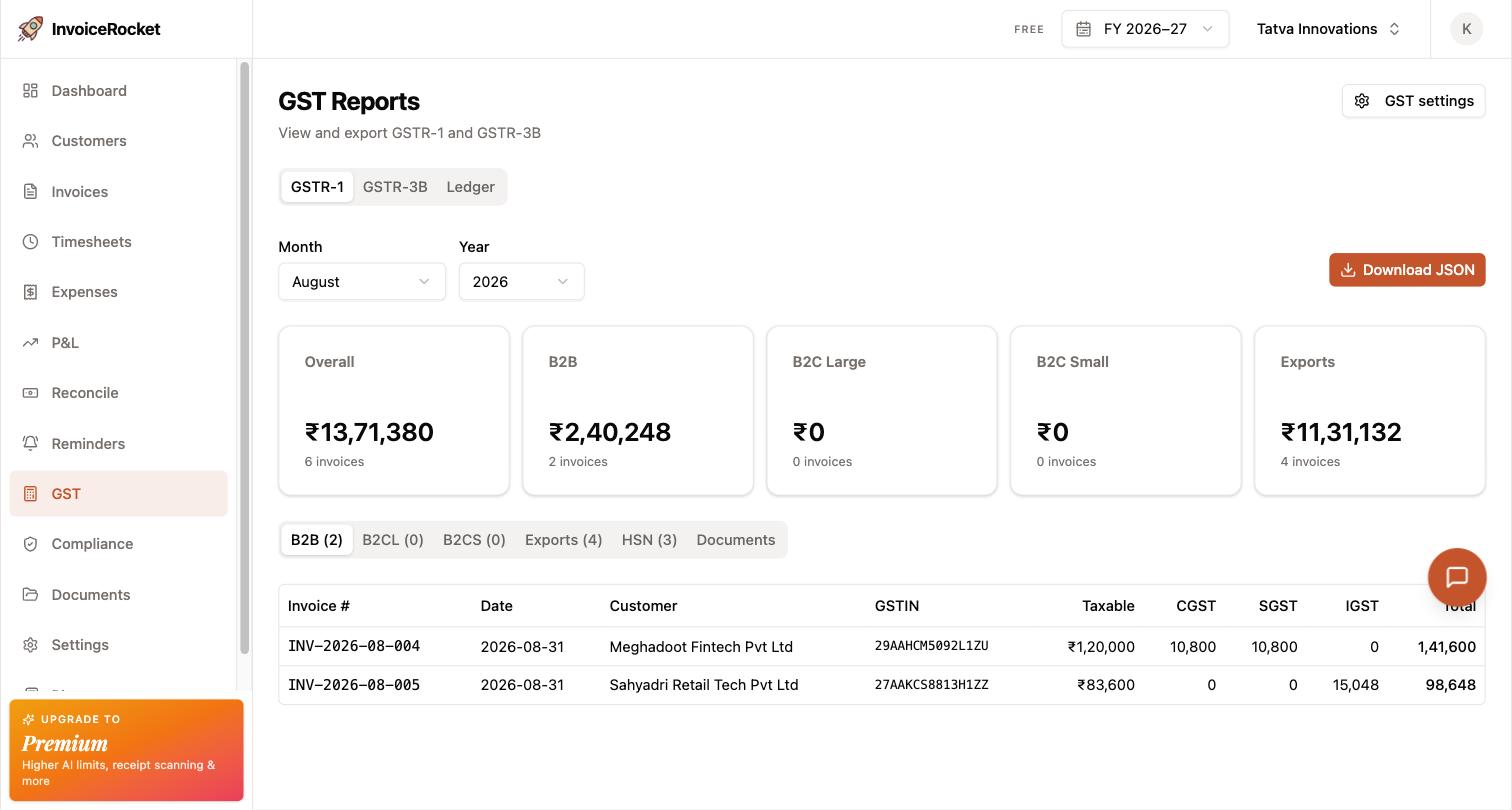
If your invoicing software is set up correctly, exporting GSTR-1 JSON should fill in all of this automatically. Upload the JSON, hit submit, sign with EVC. Done.
Filling out GSTR-3B — the boxes that matter
GSTR-3B is the simpler form. The boxes you'll actually use:
- 3.1(a) — Outward taxable supplies (other than zero-rated, nil-rated, and exempt). Your domestic taxable invoice value plus the tax (CGST + SGST or IGST).
- 3.1(b) — Outward taxable supplies (zero-rated). This is where exports under LUT and SEZ supplies go. Tax payable here is ₹0 (because LUT), but the value must show up.
- 3.1(c) — Other outward supplies (nil-rated, exempt). Usually empty for freelancers.
- 3.1(d) — Inward supplies liable to reverse charge. If you bought services from a foreign vendor (e.g. AWS, Slack, GitHub) — the value goes here, you pay IGST on it under reverse charge, and you claim it back as ITC in Table 4 in the same return. Net cash impact: zero. But you must declare it.
- 4 — Eligible ITC. Input tax credit on legitimate business purchases (laptop, software, co-working subscription, etc.).
- 5 — Exempt, nil, and non-GST inward supplies. Usually empty.
The cash you actually pay is 3.1(a) tax minus 4(C) ITC, plus the IGST on reverse-charge purchases (which you immediately recover as ITC, so net-net zero). Pay via the PMT-06 challan if you're under QRMP, or directly with GSTR-3B if you're monthly.
The reconciliation check before you file
Before you hit submit on GSTR-3B, do this 60-second check:
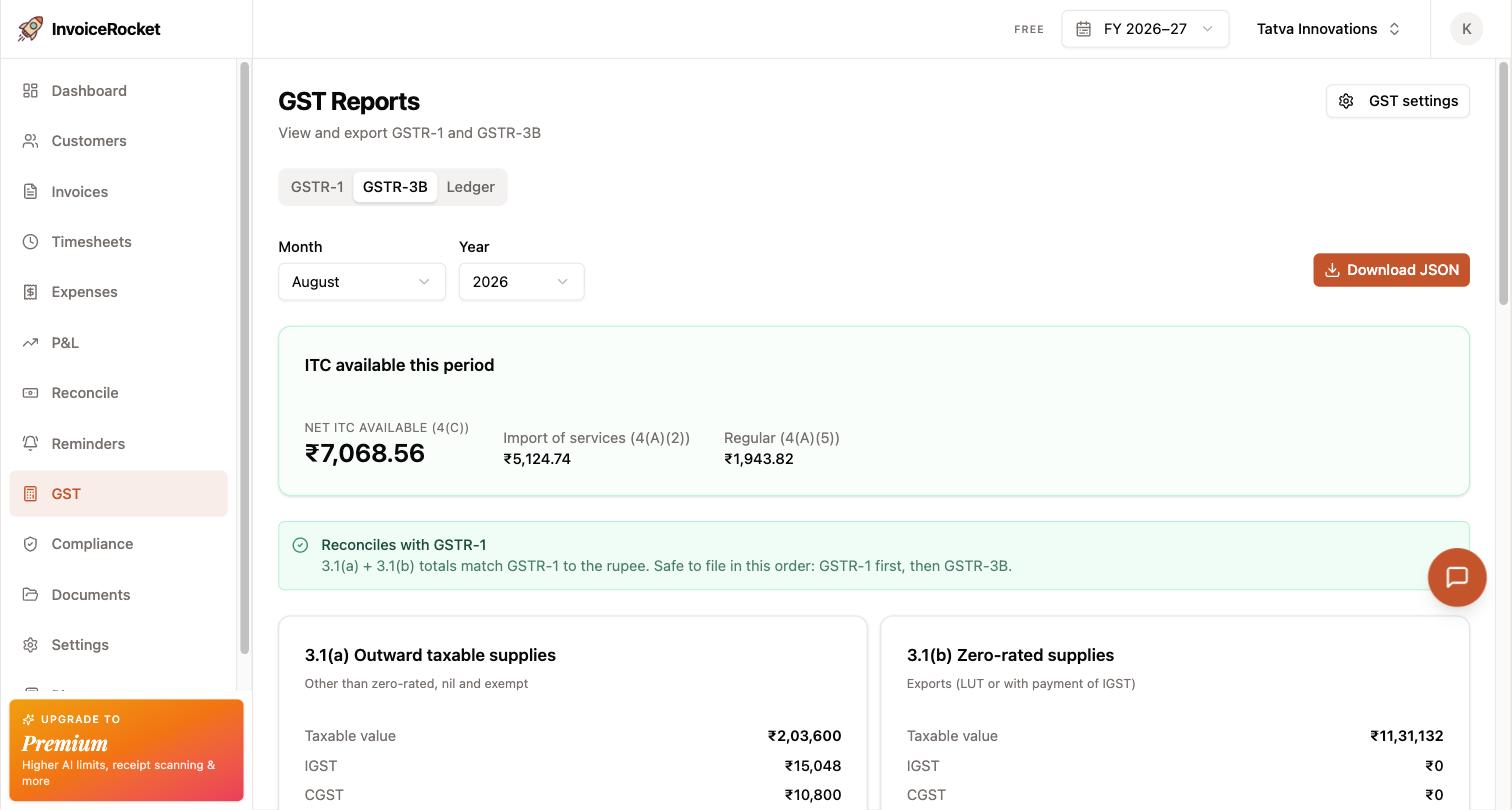
- GSTR-1 Table 4A + 5A + 6A totals = GSTR-3B Box 3.1(a) + 3.1(b), broken down correctly into taxable vs zero-rated.
- GSTR-1 Table 6A WOPAY value = GSTR-3B Box 3.1(b) value. (Both should match your total LUT-based export invoices.)
- Total invoice tax in GSTR-1 = total tax payable in GSTR-3B Box 3.1. They should match to the rupee.
- Your books / invoicing tool's "GST sales" total = GSTR-1 total = GSTR-3B 3.1 total. Three-way match.
If any of these don't reconcile, find the discrepancy before filing. The GSTN system runs the same comparison automatically and flags mismatches in your communication tray. Notices follow.
Common mistakes
Filing GSTR-3B before GSTR-1. The portal lets you, but it inverts the workflow. GSTR-1 is the source of truth; GSTR-3B should derive from it. File GSTR-1 first, then 3B with matching totals.
Filing nil returns "later". A nil return is still a return. Late fees apply even with zero turnover — ₹50/day for GSTR-3B (₹20/day for nil) and ₹50/day for GSTR-1, capped per return but compounding across months. A freelancer who skips three months of nil filings can owe ₹3,000–5,000 in late fees alone.
Forgetting reverse charge on foreign software. Buying GitHub Copilot, AWS, Notion, Slack? Those are imports of services. You owe IGST on them under reverse charge, recover it as ITC. Net zero — but skipping the disclosure is non-compliance.
Treating LUT exports as "exempt" or skipping them in GSTR-3B 3.1(b). Exports under LUT are zero-rated, not exempt. They must show up in 3.1(b) at value. If you skip them, your GSTR-1 (which has them in 6A) won't match your 3.1 — automatic mismatch flag.
Wrong place of supply on B2B invoices. Inter-state vs intra-state determines IGST vs CGST+SGST. If you're in Karnataka and your client is in Karnataka, it's CGST+SGST. If they're anywhere else, IGST. Get the client's address and GSTIN right at onboarding — fixing this in amendments later is painful.
Skipping Table 12 (HSN summary). Mandatory above ₹5 crore turnover, optional below — but the portal increasingly nudges you to fill it. For freelancers, it's two lines. Just do it.
Not opting into QRMP when eligible. Monthly filing for a freelancer with ten invoices a month is busywork. QRMP cuts your filing days from 12 per year to 4. Switch.
How GSTR-1, GSTR-3B, LUT, and 44ADA fit together
These four pieces are the entire GST + income tax compliance picture for a typical Indian freelancer:
| Piece | Frequency | What it does |
|---|---|---|
| LUT | Annual (April) | Lets you invoice exports without IGST. Detailed guide. |
| GSTR-1 | Monthly or quarterly | Reports each invoice you raised. |
| GSTR-3B | Monthly or quarterly | Summary + tax payment. |
| ITR-4 + Section 44ADA | Annual (July) | Income tax on 50% deemed profit. Detailed guide. |
Add advance tax on the income side (15 June, 15 Sept, 15 Dec, 15 March) and MSME registration for legal recourse on late payments — that's the full compliance kit. Nothing else is mandatory for a solo freelancer.
The habit that makes monthly GST effortless
Two things compound:
- Get every invoice's GSTIN, place of supply, HSN, and LUT declaration right at the time you raise the invoice. Fixing these later is 10× the work.
- Reconcile invoices to GST totals once a week, not once a quarter. Five minutes weekly catches errors when they're cheap to fix.
If your tool is doing both — flagging missing GSTIN, separating domestic and export series, generating GSTR-1 JSON, tracking the LUT realisation window — quarterly filing is genuinely a 10-minute exercise.
InvoiceRocket is built around this: GST-correct invoices by default (place of supply, HSN, LUT declaration, one continuous serial), one-click GSTR-1 JSON export with the right tables filled, and reminders for both GSTR-1 and GSTR-3B due dates. It's free for most freelancers.
The bigger point — tool or no tool: GST returns are not the scary thing. The scary thing is treating them as scary, paying someone ₹50,000 a year to do them, and never understanding what's on your own returns. Spend one weekend filing your own returns once. The rest of your career, you'll know exactly what the department sees.
Frequently asked questions
What's the difference between GSTR-1 and GSTR-3B?
GSTR-1 is your invoice-level disclosure of outward supplies — every invoice you raised, with number, date, recipient GSTIN, value and tax. It populates your client's GSTR-2A/2B so they can claim input tax credit. GSTR-3B is the summary self-assessment and payment return: totals only, and the form where you actually pay. GSTR-1 is "what you sold", GSTR-3B is "what you owe", and the two must reconcile.
Am I eligible for QRMP, and should I use it?
You're eligible if your aggregate turnover in the previous financial year was up to ₹5 crore, which covers 99% of solo freelancers. QRMP lets you file both returns quarterly while still paying tax monthly via PMT-06, cutting your filing days from 12 a year to 4. The one reason to stay monthly is a single B2B client who needs your invoices in their GSTR-2B every month — though the Invoice Furnishing Facility under QRMP can give them the same outcome.
What are the GSTR-1 and GSTR-3B due dates?
Under QRMP: GSTR-1 by the 13th of the month after the quarter, GSTR-3B by the 22nd or 24th depending on your state group, and PMT-06 monthly by the 25th. Filing monthly instead: GSTR-1 by the 11th of the following month, GSTR-3B by the 20th.
Do I have to file GST returns in a month with no income?
Yes. A nil return is still a return, and late fees apply even at zero turnover — ₹20/day for a nil GSTR-3B (₹50/day otherwise) and ₹50/day for GSTR-1. A freelancer who skips three months of nil filings can owe ₹3,000–5,000 in late fees alone.
Where do LUT exports go in GSTR-1 and GSTR-3B?
GSTR-1 Table 6A, marked WOPAY (without payment of tax). GSTR-3B Box 3.1(b), as zero-rated. Exports under LUT are zero-rated, not exempt — the value must appear in 3.1(b) even though the tax is nil. Skipping them there while they sit in GSTR-1 Table 6A produces an automatic mismatch flag.
Do I owe GST on foreign software subscriptions?
Yes. AWS, Slack, GitHub, Notion and similar are imports of services. Declare the value in GSTR-3B Table 3.1(d), pay IGST on it under reverse charge, and recover it as ITC in Table 4 of the same return. The net cash impact is zero, but omitting the disclosure is non-compliance.
What should I reconcile before filing GSTR-3B?
Four checks. GSTR-1 Tables 4A + 5A + 6A totals should equal GSTR-3B Boxes 3.1(a) + 3.1(b), split correctly into taxable versus zero-rated. Table 6A WOPAY value should equal Box 3.1(b) value. Total invoice tax in GSTR-1 should equal total tax payable in Box 3.1, to the rupee. And all of that should match your invoicing tool's GST sales total. The GSTN system runs the same comparison automatically, so mismatches surface either way.
Should I file GSTR-1 or GSTR-3B first?
GSTR-1 first. It's the source of truth, and GSTR-3B should derive from it. The portal will let you file 3B first, but that inverts the workflow and makes mismatches more likely.