
I Got a ₹15.77 Lakh GST Notice for Exporting Services Without an LUT: What It Says and How I Replied
A real DRC-01A for FY 2022-23: why the GST department taxed ₹49 lakh of freelance export income at 18%, the documents it asked for, how I built the invoice-to-FIRA reconciliation, and why a missing LUT is a curable lapse.

Freelancer for 10+ years with clients in the USA, Australia, Europe, South Africa and India. Built InvoiceRocket to keep his own invoicing, GST and Section 44ADA tracking in order, and to give his CA everything in one place.
On 28 July 2026 I received a GST DRC-01A for FY 2022-23 asking me to pay ₹15,77,002: 18% IGST on ₹49 lakh of export income, plus interest. I have freelanced for overseas clients for more than ten years. Every rupee of that income came from abroad, and I have a bank advice for every payment. The problem was one form I never filed that year: the Letter of Undertaking (LUT).
This post walks through the actual notice, what the department asked for, how I replied without a CA, and what you can check today so it never reaches you.
TL;DR. If you export services without an LUT for that financial year, the department can treat your zero-rated turnover as taxable and demand 18% IGST plus 18% interest under Section 73. A DRC-01A is the last step before a show cause notice, and you get 15 days to pay or reply in Part B. The strongest reply is an invoice-to-FIRA reconciliation proving the Section 2(6) export conditions, together with CBIC Circular 37/11/2018-GST, which says a missing LUT should not cost you zero-rating when exports are proven. The Karnataka High Court treated a missing LUT as a curable defect in June 2026. For FY 2022-23, the department's deadline to issue a Section 73 show cause notice is 30 September 2026, which is why these notices are arriving now.
I'm not a chartered accountant, and this isn't legal advice. My reply is still pending, and I'll update this post with the outcome.
What did the notice actually say?
The notice came as a pre-intimation under Section 73(5), issued under Rule 142(1A), from my jurisdictional state GST office. Its single ground was:
The turnover declared as zero-rated supply of services, to qualify as export of services, has to fulfill the conditions prescribed under Section 2(6) of IGST Act 2017.
The officer had looked at my GSTR-3B for FY 2022-23, seen ₹49,24,747 in Table 3.1(b) (zero-rated supplies), and found no LUT on record for that year. Rule 96A says you may export without paying IGST only after furnishing an LUT or bond. With no LUT, the officer's position was that IGST was payable on the whole amount.
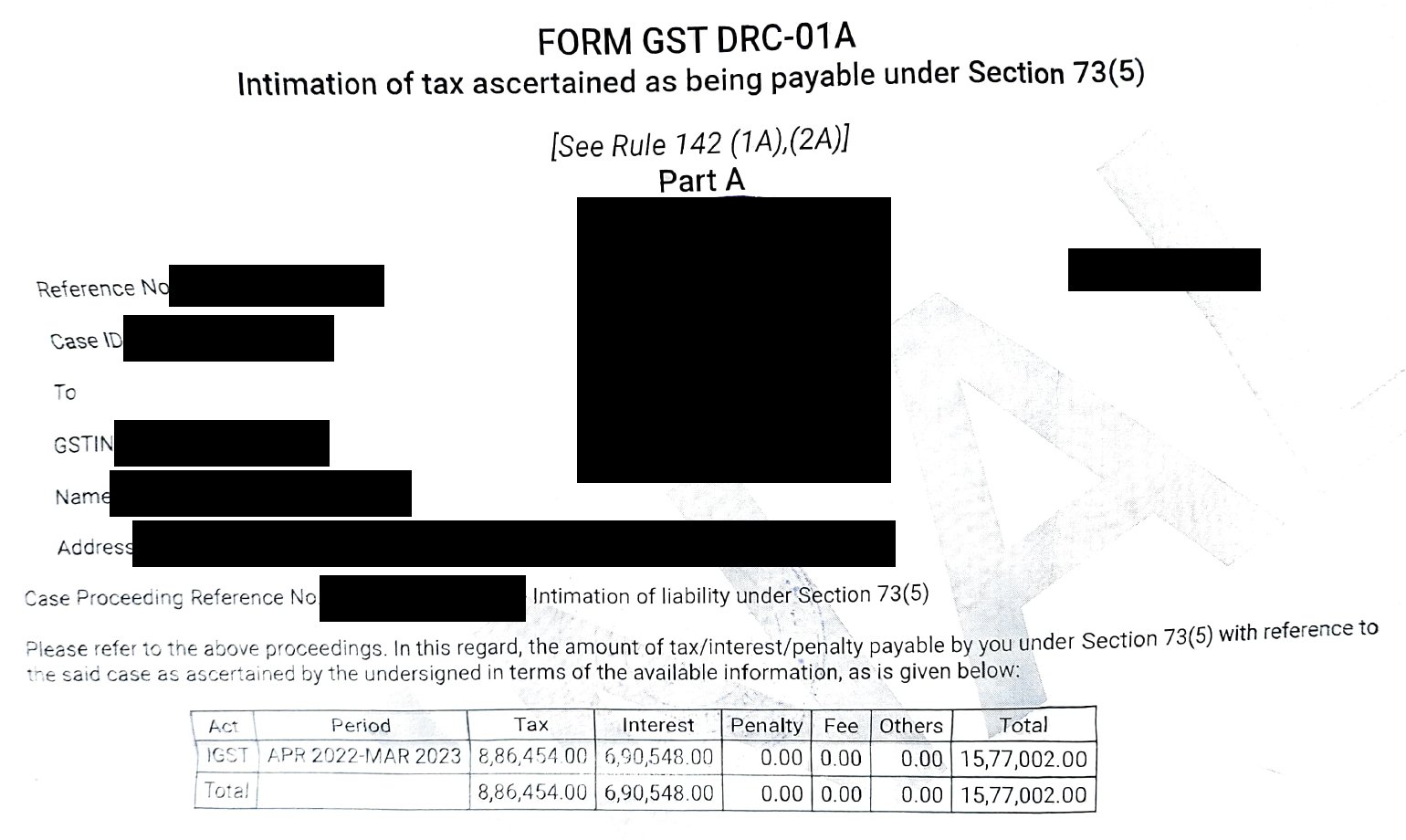
| Component | Amount |
|---|---|
| Zero-rated turnover declared in GSTR-3B 3.1(b) | ₹49,24,747 |
| Proposed IGST @ 18% | ₹8,86,454 |
| Interest @ 18% (to date of intimation) | ₹6,90,548 |
| Total demanded | ₹15,77,002 |
No penalty was included. A DRC-01A says that if you pay the tax with interest at this stage, no penalty applies and the proceedings close.
How did it get here?
Scrutiny notices under Section 61 (ASMT-10) on the same issue came first, in November 2025 and March 2026. The March ASMT-10 put interest at ₹5,59,996. By the July DRC-01A it was ₹6,90,548. About ₹1.3 lakh of interest built up in four months. Whatever you decide to do, don't let these sit.
I never replied to the November notice, because I never saw it. GST notices go to the email address and mobile number registered on the portal, and mine pointed at an inbox I had stopped using. The only reason I caught the July DRC-01A is that it also arrived as registered post at my address. Had it been email alone, I would have learned about the whole thing at the recovery stage, with interest still climbing.
Two habits follow from that. Make sure the email and mobile on your GST registration are ones you actually read, and open Services → User Services → View Additional Notices/Orders on the portal every couple of months. Notices sit there whether or not the email reaches you, and the clock runs from the date on the notice, not the date you read it.
The usual sequence under Section 73 is:
- ASMT-10: scrutiny of returns, where you're asked to explain a discrepancy.
- DRC-01A: tax "ascertained" as payable. Pay or reply within the stated date (15 days here).
- DRC-01: show cause notice under Section 73(1) if the reply isn't accepted.
- DRC-07: the order. Under Section 73, the penalty is 10% of tax or ₹10,000, whichever is higher. It's waived if you pay within 30 days of the show cause notice.
Why are FY 2022-23 notices arriving now?
Under Section 73(10), the order for a financial year must be issued within three years of the due date of that year's annual return. The show cause notice must go out at least three months before that. The GSTR-9 for FY 2022-23 was due on 31 December 2023, so:
- Last date for a Section 73 show cause notice for FY 2022-23: 30 September 2026
- Last date for the order: 31 December 2026
Officers are clearing that year's scrutiny cases before the window closes. If you exported services in FY 2022-23 and your LUT for that year is missing, a notice is likely.
What documents did the department ask for?
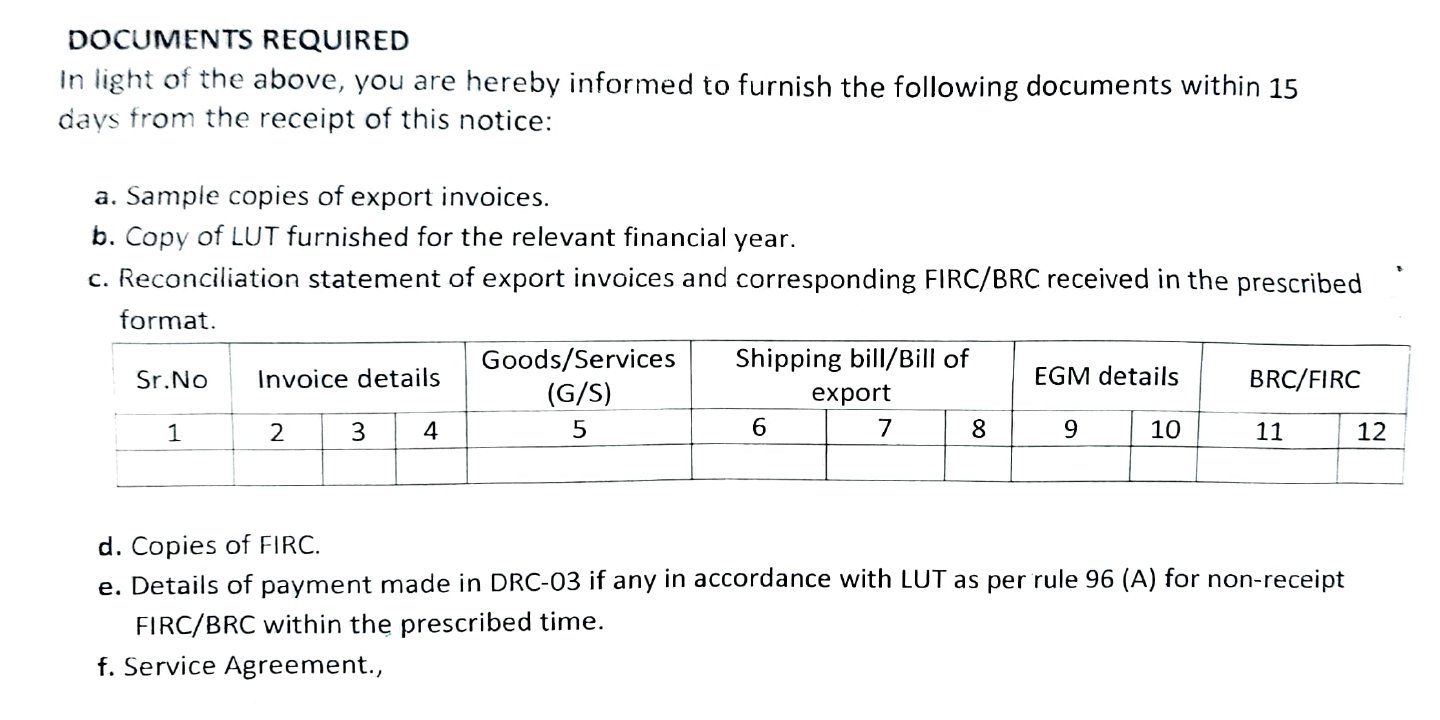
- Sample copies of export invoices
- Copy of the LUT for the relevant financial year
- Reconciliation of export invoices with the corresponding FIRC/BRC, in a prescribed format
- Copies of FIRC
- DRC-03 payment details, if any, for invoices where foreign exchange was not received in time under Rule 96A
- Service agreement
The prescribed reconciliation table has columns for shipping bill / bill of export and EGM details. Those only exist for goods. A freelancer exporting services has neither, so mark them "Not applicable: export of services" and put your effort into the invoice and FIRC columns.
How did I build the reconciliation?
This is the core of the reply. For every export invoice raised in FY 2022-23, one row:
| Column | What I filled in |
|---|---|
| Sr. No. | Running number |
| Invoice number and date | As issued |
| Client name and country | Recipient outside India |
| Goods / Services | S |
| Invoice value (foreign currency) | e.g. USD 4,000.00 |
| Invoice value (INR) | At the rate reported in the return |
| Shipping bill / EGM | Not applicable: export of services |
| FIRA / FIRC number and date | From the bank's inward remittance advice |
| Amount realised (foreign currency and INR) | As credited |
| Purpose code | e.g. P0802 for software consulting |
The row totals should tie back to the ₹49,24,747 in GSTR-3B. Where one payment covered several invoices, or one invoice was paid in parts, I added a short note on that row rather than leaving the officer to work it out.
Why this matters legally. Section 2(6) of the IGST Act treats a supply as an export of services only when all five conditions hold:
- the supplier is located in India,
- the recipient is located outside India,
- the place of supply is outside India,
- payment is received in convertible foreign exchange (or in INR where RBI permits), and
- supplier and recipient are not merely establishments of the same person.
The invoices and agreements cover conditions 1, 2, 3 and 5. The FIRAs cover condition 4. None of the five mentions an LUT. That's why the reconciliation carries most of the weight.
Why is a missing LUT not fatal?
CBIC Circular No. 37/11/2018-GST (15 March 2018) was issued for exactly this situation. It says the substantive benefit of zero-rating should not be denied where exports have actually been made. It also says a delay in furnishing the LUT can be condoned, and the LUT accepted ex post facto, depending on the facts of each case.
The Karnataka High Court applied the same reasoning in Nuvteq Solutions Pvt. Ltd. v. Joint Commissioner of Commercial Taxes (WP No. 16115 of 2026, decided 10 June 2026). The department had confirmed a ₹72 lakh demand on export services because no LUT was filed. The court held that not filing an LUT under Rule 96A is a curable defect. It set aside the orders and sent the case back so the LUT could be filed ex post facto.
So my Part B reply argued two things:
- The exports are real and fully realised. Here is every invoice matched to a FIRA, which meets Section 2(6).
- The missing LUT is a procedural lapse. Under Circular 37/11/2018-GST, and as the Karnataka High Court held in Nuvteq Solutions, it does not turn proven exports into taxable supplies.
I attached the reconciliation, the invoices, all FIRAs and the client agreements.
How do you reply to a DRC-01A on the GST portal?
- Log in at gst.gov.in and go to Services → User Services → View Additional Notices/Orders.
- Open the case and find the DRC-01A intimation.
- Choose to reply (Part B). Say whether you accept the ascertained amount in full, in part, or not at all. If you don't accept it, give your grounds.
- Upload your written reply and supporting documents as PDFs. Keep each file within the portal's size limit, and split large FIRA sets if needed.
- File it before the date in the intimation and save the acknowledgement.
If some invoices genuinely were never paid in foreign exchange, deal with those separately. Paying the tax on only those through DRC-03 is cleaner than defending all of them together.
What should you check today?
Ten minutes on the GST portal and in your bank's inbox:
- LUT for every export year. Services → User Services → View My Submitted LUTs. Check there's an LUT for every financial year you billed foreign clients in, not just the current one.
- LUT for FY 2026-27. If it's missing, file it now. Our LUT filing guide takes about ten minutes.
- Contact details you actually monitor. Check the email and mobile on your GST registration, and look at View Additional Notices/Orders while you're on the portal. A notice you never opened still counts as served.
- A FIRA for every foreign payment, with a correct purpose code, and each one traceable to an invoice.
- Export invoices showing the LUT ARN and "supply meant for export under LUT without payment of integrated tax". The full list of fields is in the minimum documentation guide.
- A signed agreement or SOW with each overseas client, showing they are located outside India.
- Returns that tie out. Export turnover in GSTR-1 should match GSTR-3B Table 3.1(b). See the GSTR-1 & GSTR-3B checklist.
If a past year has no LUT, don't wait for the notice. Build the invoice-to-FIRA reconciliation for that year now, while your bank advices are still easy to download.
Frequently asked questions
What is a DRC-01A in GST?
DRC-01A is an intimation of tax ascertained as payable, issued under Rule 142(1A) before a show cause notice under Section 73 or 74. It gives you a chance to pay the tax with interest, and avoid penalty, or to object in Part B before formal proceedings start.
Can the GST department charge IGST on export of services if I didn't file an LUT?
It can propose it. Rule 96A requires an LUT or bond before exporting without paying IGST. But CBIC Circular 37/11/2018-GST says zero-rating should not be denied when exports are proven, and the Karnataka High Court held in June 2026 that a missing LUT is a curable defect. Proving the Section 2(6) conditions with invoices and FIRAs is the core of the defence.
Can I file an LUT for a previous financial year?
The portal lets you file an LUT only for the current financial year. For a past year, you ask the jurisdictional officer to condone the delay and accept the LUT ex post facto, which Circular 37/11/2018-GST allows case by case.
What is the last date for a GST Section 73 notice for FY 2022-23?
The show cause notice must be issued by 30 September 2026, and the order by 31 December 2026. Both are counted from the 31 December 2023 due date of the FY 2022-23 annual return.
Is FIRA enough, or do I need a FIRC?
For this reconciliation, a bank-issued FIRA showing the remitter, amount, currency, purpose code and date served the purpose. Ask for a formal FIRC only if the officer specifically insists on one.
What happens if I ignore a DRC-01A?
The notice says a show cause notice under Section 73(1) will follow, and interest keeps running. In my case, interest grew by about ₹1.3 lakh between the ASMT-10 and the DRC-01A. Reply or pay before the date given.
What if the notice went to an email address I no longer use?
It still counts as served, and the reply clock still runs from the date on the notice. That's how I missed an ASMT-10 for eight months. Update the email and mobile on your GST registration, and check Services → User Services → View Additional Notices/Orders on the portal every couple of months rather than relying on email.
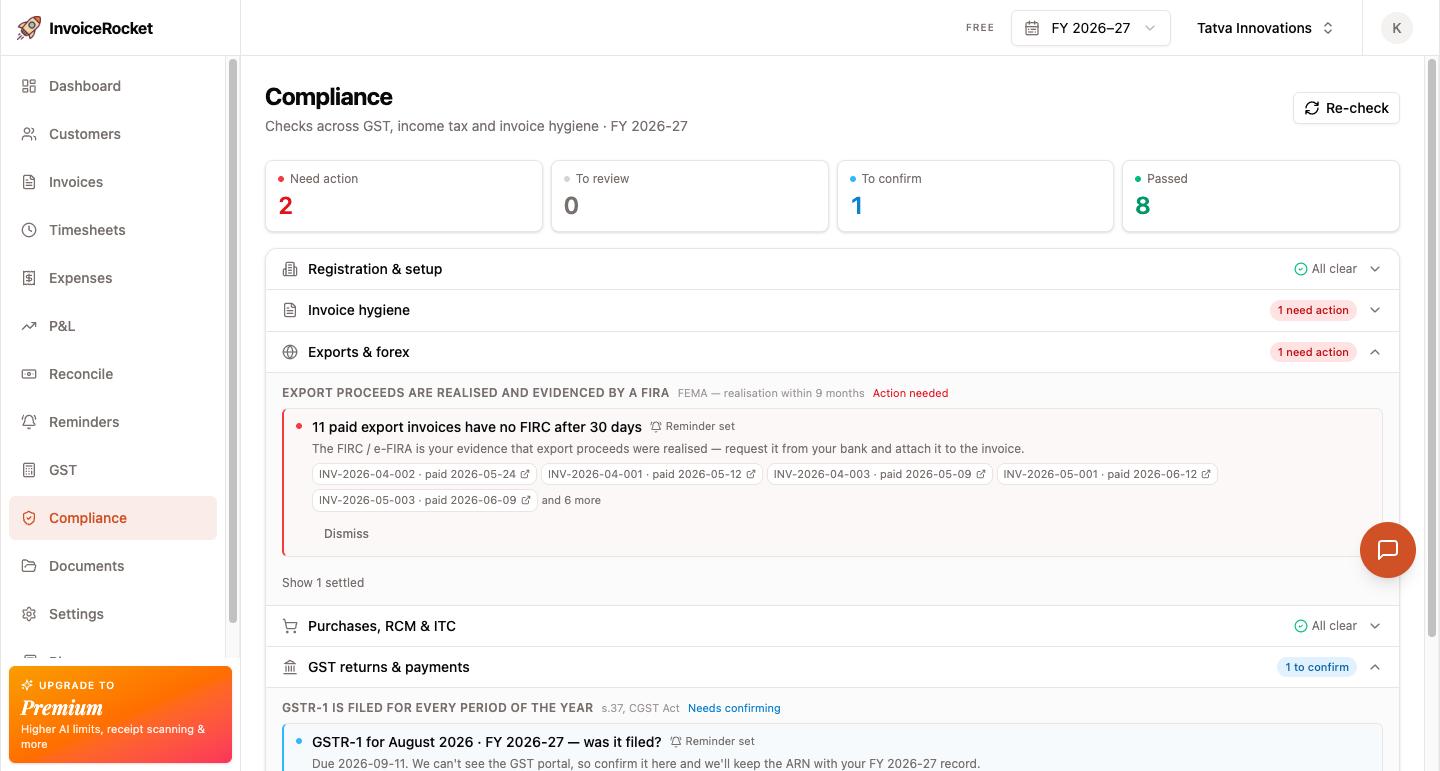
I built InvoiceRocket partly because of notices like this one. Its compliance check flags every zero-GST export invoice with no LUT covering its date, and every paid export invoice with no FIRC attached, while the fix is still one form and a download from your bank rather than a reconciliation years later.
Send your first GST-compliant invoice free. Every export invoice gets the LUT reference and zero-rated declaration automatically.