
Minimum Documentation for Indian Freelancers Working with Overseas Clients (2026 Guide)
The complete compliance checklist for Indian freelancers earning under ₹75 lakh from foreign clients: GST registration, LUT, FIRA/FIRC, advance tax, professional tax, and ITR — in the order you'll actually need them.

Freelancer for 10+ years with clients in the USA, Australia, Europe, South Africa and India. Built InvoiceRocket to keep his own invoicing, GST and Section 44ADA tracking in order, and to give his CA everything in one place.
If your freelance income comes mostly from overseas clients and your annual receipts are under ₹75 lakh, the compliance list is short — but every item on it has a deadline, and missing one is expensive. This guide is the minimum set of registrations, filings, and records you need to stay clean with GST, RBI/FEMA, and Income Tax. In the order you'll actually run into them.
TL;DR. Register for GST once turnover crosses ₹20 lakh (₹10 lakh in special-category states). File LUT (Form RFD-11) every financial year by 31 March to export without IGST. File GSTR-1 + GSTR-3B (quarterly under QRMP if turnover < ₹5 cr). Collect FIRA/FIRC from your bank for every foreign payment — RBI requires realisation within 15 months of invoice (9 months for invoices before 1 October 2026), and from October you declare each month's export invoices to your bank on an EDF. Pay advance tax quarterly. File ITR under Section 44ADA (50% presumptive, eligible up to ₹75 lakh when ≥95% of receipts are digital).
Deadlines at a glance
| Filing | Cadence | Deadline |
|---|---|---|
| GSTR-1 (sales) | Quarterly (QRMP) | 13th of month after quarter |
| GSTR-3B (summary) | Quarterly (QRMP) | 22nd/24th of month after quarter |
| PMT-06 (monthly tax under QRMP) | Monthly | 25th of next month |
| LUT renewal (Form RFD-11) | Annual | 31 March (for next FY) |
| Advance tax | Quarterly cumulative | 15 Jun (15%), 15 Sep (45%), 15 Dec (75%), 15 Mar (100%) |
| GSTR-9 (annual, optional below ₹2 cr) | Annual | 31 December |
| ITR (no audit) | Annual | 31 July |
| Professional tax | Annual / monthly | State-dependent |
Who this is for
- Indian resident, individual freelancer (not a registered company)
- Annual gross receipts under ₹75 lakh
- Earning primarily from overseas clients in foreign currency (services exported, paid by SWIFT/wire to an Indian bank)
- Receipts mostly digital (bank transfer, not cash) so 44ADA's ₹75L cap applies
Prerequisites (one-time, before anything else)
- PAN in your own name, and a dedicated current or savings account for business receipts. Mixing personal and business money makes everything below harder.
- MSME / Udyam registration at udyamregistration.gov.in — free, takes 10 minutes, and unlocks the MSMED Act's delayed-payment protections against domestic clients.
1. Do I need to register for GST?
Yes, once your annual turnover crosses ₹20 lakh (₹10 lakh if you're in a special-category/NE state). Even though export of services is "zero-rated" — meaning you charge 0% GST to your overseas client — that's zero-rated, not exempt. The threshold and registration requirement still apply. Below the threshold you can stay unregistered, but most freelancers register voluntarily once foreign income starts flowing in. Register at gst.gov.in. See our Upwork freelancer GST guide for the full registration walkthrough.
2. File a LUT immediately after GST registration
A Letter of Undertaking (Form GST RFD-11) lets you export services without charging IGST. Without an LUT in place, you must pay 18% IGST on every export invoice and then claim a refund — a multi-month cash-flow drag you don't want. The LUT is filed online on the GST portal and must be renewed at the start of every financial year (by 31 March for the next FY). This is the single most-missed annual step for freelance exporters. Step-by-step in our LUT filing guide.
3. What must your export invoice actually contain?
Filing the LUT is only half the work — the invoice itself has to look like an export invoice, or your GST returns won't reconcile and your bank may flag the remittance. At a minimum, every export invoice should include:
- Your name, address, and GSTIN
- A sequential invoice number in a consistent series (max 16 characters, must increment without gaps or out-of-order numbers, no resets mid-year)
- Date of issue
- Recipient's name, address, and country
- SAC (Services Accounting Code) — typically
998314for IT consulting,998313for software development,998311for management consulting - Description of services, quantity / hours where applicable
- Currency and total in foreign currency (USD, EUR, etc.)
- Place of supply — for exports, this is the recipient's country
- LUT reference number and the declaration: "SUPPLY MEANT FOR EXPORT UNDER LUT WITHOUT PAYMENT OF INTEGRATED TAX"
- Tax columns shown as zero (CGST / SGST / IGST = 0%) since it's zero-rated
Missing the LUT reference or the export declaration is the most common mistake — without them an invoice can be treated as a regular taxable supply during a GST audit. InvoiceRocket's free GST invoice generator fills all of this — SAC, LUT reference, place of supply, zero-rated declaration — automatically once you set your business profile.
4. File GSTR-1 and GSTR-3B (use QRMP)
Under the QRMP scheme (Quarterly Return, Monthly Payment), if your turnover is under ₹5 crore you file GSTR-1 and GSTR-3B quarterly instead of monthly. You still pay any tax due monthly via Form PMT-06. For pure exporters under LUT, the tax due is usually nil, so QRMP is essentially "two filings a quarter, zero payment". GSTR-9 (annual return) is optional below ₹2 crore turnover but recommended for clean records. Full filing checklist: GSTR-1 & GSTR-3B monthly guide.
5. Track FIRA / FIRC for every foreign payment
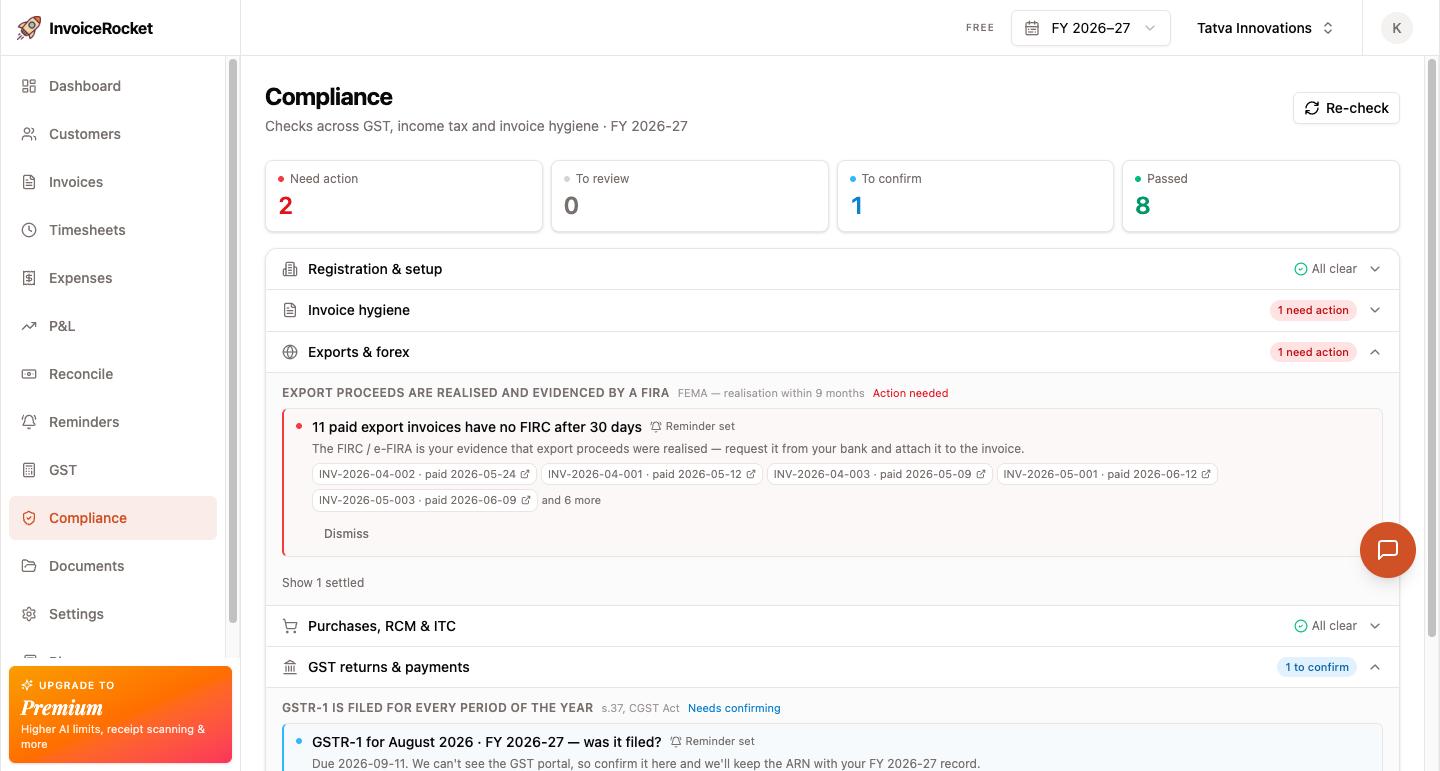
A FIRA (Foreign Inward Remittance Advice) or FIRC (Certificate) is your bank's proof that you received money from abroad. You need it to claim export status under GST, claim deductions under Income Tax, and stay on the right side of RBI/FEMA. Most banks now issue an electronic FIRA automatically; some charge for a physical FIRC.
Insist on foreign currency, not INR. GST law treats a supply as "export of services" only when payment is received in convertible foreign exchange (USD, EUR, GBP, etc.) — or in INR where specifically permitted by RBI. If your overseas client routes money through a payment processor that lands INR in your account with no clear FIRA, you're not technically wrong, but in a GST audit you'll have to prove the funds originated abroad. That means hunting down processor statements, SWIFT references, and remitter details months or years later. Save yourself the pain: ask clients to wire foreign currency directly to your AD bank, and confirm the FIRA carries the correct purpose code —
P0802for software consulting,P0807for business/management consulting,P1006for technical consulting. A wrong purpose code can mark your income as something it isn't and trigger queries from both RBI and GST.
RBI/FEMA requires the payment to be realised in India within 15 months of invoice date (18 months if invoiced in rupees). This applies to invoices dated from 1 October 2026; older invoices keep the old 9-month limit. If you export under LUT, GST still wants the money within one year. From the same date, SOFTEX is replaced by a monthly Export Declaration Form (EDF) that every service exporter files with their AD bank. See the EDF guide. Optional but useful: open an EEFC account to hold foreign currency without immediate conversion.
6. Pay advance tax every quarter
If your total income tax liability for the year exceeds ₹10,000, you must pay advance tax in four cumulative instalments:
| Due date | Cumulative % of annual tax |
|---|---|
| 15 June | 15% |
| 15 September | 45% |
| 15 December | 75% |
| 15 March | 100% |
Missing instalments triggers interest under Sections 234B and 234C. Pay online at incometax.gov.in via Challan ITNS-280. Most freelancers underestimate Q1 (15 June) because the year just started — set a calendar reminder.
7. Pay professional tax (if your state levies it)
Professional tax is a state-level tax, not central. It's levied in Karnataka, Maharashtra, West Bengal, Tamil Nadu, Andhra Pradesh, Telangana, Gujarat, Kerala, and a few others. It is not levied in Delhi, UP, Haryana, Rajasthan, Punjab, or J&K. Where applicable it's capped at ₹2,500 per year and usually paid annually (Karnataka) or monthly (Maharashtra). Check your state's commercial tax website.
8. File your Income Tax Return — use Section 44ADA
If your gross receipts are under ₹75 lakh (the cap drops to ₹50 lakh if less than 95% of your receipts are digital), file ITR-4 under Section 44ADA. You declare 50% of receipts as profit and pay tax on that — no books of accounts required, no audit. It's the simplest and almost always the most tax-efficient route for a freelance developer. Before filing, review Form 26AS, AIS, and TIS on the income-tax portal to catch any TDS or high-value transaction mismatches. Deep-dive: Section 44ADA tax savings for Indian freelancers.
Frequently asked questions
Do I need GST registration if all my clients are abroad?
Only once your turnover crosses ₹20 lakh (₹10 lakh in special-category states). Export of services is zero-rated, not exempt, so the registration threshold still applies — but below it you can stay unregistered.
What must my export invoice contain?
At a minimum: your GSTIN, a sequential invoice number (no gaps or resets mid-year), the recipient's name and country, the relevant SAC (e.g. 998314 for IT consulting, 998313 for software development), the amount in foreign currency, place of supply (the recipient's country), your LUT reference number, and the declaration "SUPPLY MEANT FOR EXPORT UNDER LUT WITHOUT PAYMENT OF INTEGRATED TAX". Tax columns must show 0% since it's zero-rated.
What happens if I don't file LUT?
You must charge 18% IGST on every export invoice and then file a refund claim to get it back. The refund typically takes 2–3 months, which is a serious cash-flow hit. Always file LUT at the start of the FY.
Is FIRC mandatory or is FIRA enough?
A FIRA is the everyday electronic advice your bank issues automatically; a FIRC is the formal certificate (sometimes paid). For GST and Income Tax purposes, an FIRA carrying the remitter name, amount, purpose code, and date is sufficient. Request a formal FIRC only if a specific filing or refund explicitly demands one.
Can I use Section 44ADA if I'm GST registered?
Yes. GST and Income Tax are independent. GST registration has no effect on your ability to file under 44ADA, as long as your gross receipts stay within the ₹75 lakh (or ₹50 lakh) cap.
What if I cross ₹75 lakh mid-year?
You lose 44ADA eligibility for that year and must maintain proper books of accounts and get a tax audit under Section 44AB. Plan ahead — if you're tracking towards ₹75L by January, set up bookkeeping immediately rather than scrambling in July.
What if my overseas client sends INR instead of foreign currency?
GST treats a supply as "export of services" only when paid in convertible foreign exchange (or in INR where RBI specifically permits). An INR transfer with no FIRA forces you to prove foreign origin via processor statements and SWIFT references during a GST audit. Always ask clients to wire foreign currency directly to your AD bank with the correct purpose code (e.g. P0802 for software consulting).
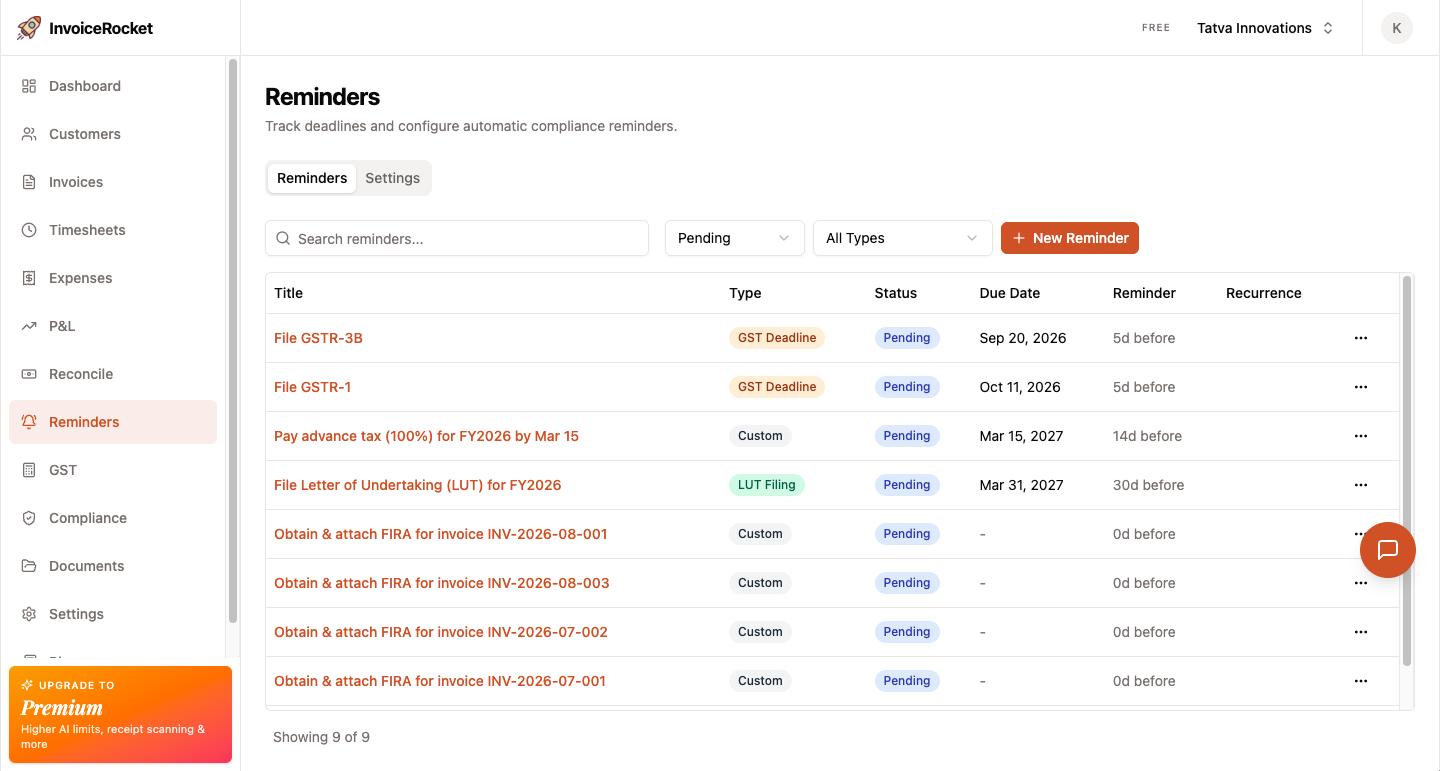
Most of these compliance items aren't hard — they're just easy to forget. InvoiceRocket's actions & reminders feature ships with built-in templates for LUT renewal, GSTR-3B, GSTR-1, professional tax, and advance tax instalments, so the deadlines come to you instead of the other way around.
And our free GST invoice generator fills the GSTIN, place of supply, and zero-rated supply notes correctly for exports.