
TDS for Indian Freelancers: Section 194J, Form 26AS, and Getting Your Money Back
Your Indian clients withhold 10% of every invoice. Under Section 44ADA you're taxed on half your receipts. That gap is a refund you have to claim — and the reconciliation that gets it wrong turns it into a demand instead.

Freelancer for 10+ years with clients in the USA, Australia, Europe, South Africa and India. Built InvoiceRocket to keep his own invoicing, GST and Section 44ADA tracking in order, and to give his CA everything in one place.
If you invoice Indian companies, you are not paid what you invoice. Your client withholds a slice under Section 194J and deposits it against your PAN, and you get the rest. Done right, that withheld money comes back to you as a refund every single year. Done wrong, it turns into a tax demand for money you already paid.
The reason freelancers get this wrong is not laziness. It is that TDS reconciliation is the one part of freelance compliance where your records and the department's records are both partial, and the mismatch between them is what generates notices.
TL;DR. Indian clients deduct TDS under Section 194J — 10% on professional fees, 2% on technical services, 20% if you haven't given them your PAN. From FY 2025-26 the threshold rose from ₹30,000 to ₹50,000 per category per year. TDS is deducted on the taxable value, not on the GST. Because 44ADA taxes you on 50% of receipts while TDS is withheld on 100%, most freelancers are structurally over-withheld and owed a refund every year — you have to claim it by filing. Reconcile Form 26AS, AIS and TIS against your own invoice records before filing, because a mismatch is what converts a refund into a demand.
This is an explainer, not professional tax advice. Rates, thresholds and forms change every budget — confirm current numbers with a CA or on the income-tax portal before you file.
What Section 194J actually is
When an Indian business pays you for professional or technical services, the law makes them responsible for withholding a portion of your fee and depositing it with the government against your PAN. You receive the net; the withheld amount sits as a credit in your name.
It is not an extra tax. It is prepayment of your income tax, collected from your client instead of from you. Every rupee withheld is a rupee off your final bill — or a refund, if it exceeds what you owe.
Individuals and HUFs are generally not required to deduct unless they were subject to tax audit in the preceding year, which is why a solo client paying you personally usually doesn't withhold, while any company does.
10% or 2%? The distinction that gets mis-set
Section 194J does not have one rate. Which one applies turns on what you actually supplied:
| Nature of payment | Rate |
|---|---|
| Professional fees (legal, medical, architectural, accountancy, technical consultancy) | 10% |
| Fees for technical services | 2% |
| No PAN furnished (Section 206AA) | 20% |
For a freelance developer this line is genuinely blurry, and clients set it in their AP system once and never revisit it. Two consequences worth knowing:
- It is your client's call, and their liability if wrong. You cannot unilaterally instruct them to deduct at 2%. If they deduct at the wrong rate, interest under Section 201(1A) and expense disallowance land on them, not you.
- Either way you are made whole. A higher deduction is not money lost — it is a larger credit and a larger refund. Getting deducted at 10% when 2% arguably applied costs you cash flow, not tax.
The one rate you should never accept passively is 20%. That is the no-PAN rate, and it means your PAN never reached your client's finance team. Fix it at onboarding, not at year end.
The threshold moved: ₹30,000 → ₹50,000
From FY 2025-26, the Section 194J threshold rose from ₹30,000 to ₹50,000. Below that, no deduction is required.
Two details people misread:
- The threshold is per category, aggregated across the year — professional fees, technical fees and royalty each get their own ₹50,000 test. It is not per invoice.
- Crossing it is not prospective-only. Once your aggregate crosses the threshold, deduction applies to the payments, so a client who has paid you ₹48,000 and is about to pay ₹10,000 will typically deduct on the full aggregate rather than on the ₹8,000 of excess.
For a freelancer with a handful of small Indian clients, this change genuinely removes some of them from TDS entirely.
TDS comes off the taxable value, not the GST
This one costs people real money because they under-invoice or over-expect.
If you raise an invoice for ₹1,00,000 plus 18% GST, the invoice total is ₹1,18,000. TDS is computed on ₹1,00,000, not on ₹1,18,000 — the GST component is explicitly excluded where it is shown separately on the invoice.
So the arithmetic on a ₹1,00,000 professional-fee invoice to an Indian company:
| Line | Amount |
|---|---|
| Taxable value | ₹1,00,000 |
| GST @ 18% | ₹18,000 |
| Invoice total | ₹1,18,000 |
| TDS @ 10% on taxable value | (₹10,000) |
| Bank credit you receive | ₹1,08,000 |
You still owe the full ₹18,000 GST to the department, even though you were only paid ₹1,08,000. The ₹10,000 is not gone — it's sitting against your PAN — but it is not available to pay this month's GST with. This is the single most common cash-flow surprise for freelancers who just registered for GST.
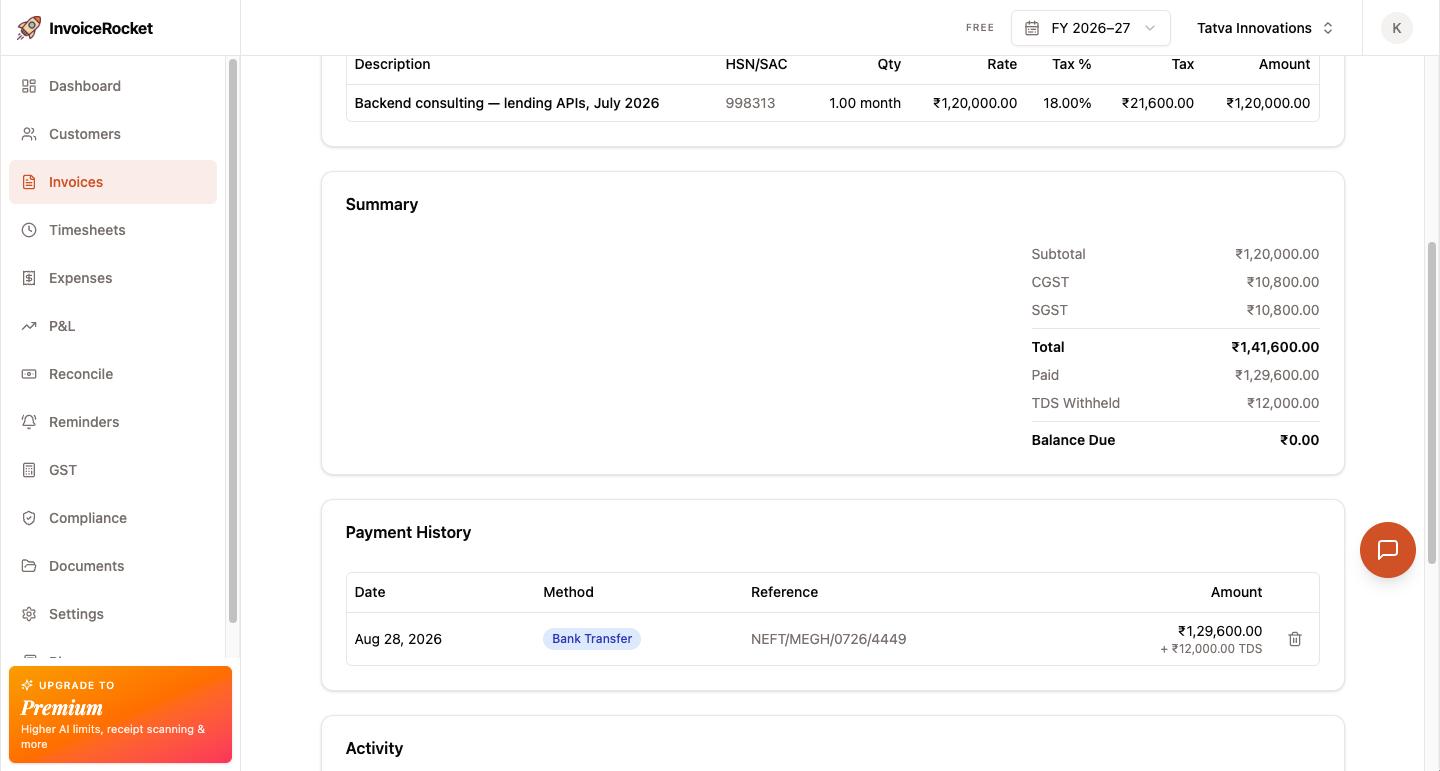
Which means: show GST as a separate line on every invoice. If you bundle it into one figure, a cautious AP team will deduct TDS on the whole ₹1,18,000, and you'll spend a quarter getting it corrected.
Why 44ADA freelancers are owed a refund almost every year
Here is the structural point that most freelancers never quite work out.
TDS is withheld on 100% of your receipts. Under Section 44ADA, you are taxed on 50% of your receipts. Those two facts do not cancel out — they guarantee over-withholding for most people.
A worked example, using the same new-regime slabs as the 44ADA guide. Say you bill Indian clients ₹24,00,000 in professional fees over the year:
| Amount | |
|---|---|
| Gross receipts | ₹24,00,000 |
| TDS withheld by clients @ 10% | ₹2,40,000 |
| Presumptive profit under 44ADA (50%) | ₹12,00,000 |
| Tax on ₹12,00,000 (new regime) | ~₹80,000 |
| Plus 4% cess | ~₹83,200 |
| Refund due to you | ~₹1,56,800 |
You prepaid roughly three times your actual liability. That money only comes back if you file and claim it. Freelancers who skip filing because "TDS was already deducted, so I've paid my tax" are making a gift to the government of, in this example, over ₹1.5 lakh.
Two practical follow-ons:
- Advance tax may still apply. 44ADA does not exempt you, but TDS credits count toward the liability. If TDS already covers what you owe, your advance tax obligation may be nil. Work it out rather than assuming either way.
- This is why the refund is the norm, not a red flag. A large refund on a freelance return is the expected shape of 44ADA plus 194J, not evidence of an aggressive claim.
Reconciling: 26AS, AIS, TIS
Three documents on the income-tax portal describe what the department thinks happened. They are not interchangeable:
- Form 26AS — the tax credit statement. TDS deposited against your PAN, by whom, in which quarter. This is the authoritative credit record.
- AIS (Annual Information Statement) — a wider picture: TDS plus reported receipts, interest, high-value transactions. More complete, and more likely to contain something you disagree with.
- TIS (Taxpayer Information Summary) — the department's condensed, category-level view derived from AIS. This is closest to what actually drives scrutiny.
Check all three before you file. They can disagree with each other, and AIS lets you submit feedback on entries you believe are wrong — which is far cheaper before filing than after a demand.
The reconciliation itself is a three-way match:
- Your invoices → total professional fees billed to Indian clients, at taxable value
- Your bank credits → net amounts actually received
- Form 26AS → TDS credited against your PAN
The identity that should hold: taxable value − TDS in 26AS = net bank credits (for the invoices settled in the period). Where it doesn't, one of three things is true.
When the numbers don't match
Your client deducted but didn't deposit. The money left your invoice and never reached your PAN. It won't appear in 26AS, and you cannot claim credit for it. Chase the client for Form 16A — a client who has deducted but not deposited is in default, and they generally fix it quickly once asked in writing.
Your client deposited against the wrong PAN or quarter. Common with a typo'd PAN at onboarding. The fix is on their side: they file a correction statement. Nothing you do on your return can conjure the credit.
Timing across financial years. You invoiced in March; they paid and deducted in April. Your books say FY1, 26AS says FY2. Neither is wrong. Claim the credit in the year it appears in 26AS, matched to the income you're offering for tax — this is the single most common source of "my numbers don't tie" and it usually isn't an error at all.
You forgot an invoice. It happens. AIS knows about it because your client reported it.
The reason to care: the department runs this comparison automatically. A gap between the receipts your clients reported and the income you declared is one of the most reliably flagged mismatches on small-taxpayer returns, and it arrives as a demand rather than a question.
Mistakes I see freelancers make
Not filing because "TDS was already deducted." The most expensive error in this post. TDS is a prepayment, usually an over-payment. Not filing means not claiming it back.
Treating the bank credit as the invoice amount. Your income is the taxable value you invoiced, not the net that landed. Booking the net understates your receipts, which then disagrees with AIS.
Chasing Form 16A instead of checking 26AS. 26AS is the authoritative record and it's available to you on demand. Form 16A is useful evidence when something is missing, not the primary source.
Letting a 20% deduction slide. That is the no-PAN rate. It means your PAN never got into your client's system. It's recoverable as credit, but you've handed over twice the cash for no reason.
Bundling GST into a single invoice figure. Invites TDS on the GST-inclusive total. Show taxable value, GST, and total as separate lines. Our free GST invoice generator lays them out correctly by default.
Reconciling once, in July. The mismatches that are cheap to fix in September are expensive in July. Check 26AS quarterly, when your clients file their TDS returns.
How TDS fits with everything else
| Piece | Cadence | What it does |
|---|---|---|
| TDS (194J) | Per payment, by your client | Prepays your income tax; claim as credit |
| Advance tax | Quarterly | Tops up whatever TDS didn't cover |
| GSTR-1 / GSTR-3B | Monthly or quarterly | Sales reporting and GST payment. Guide. |
| Section 44ADA + ITR | Annual, July | Income tax on 50% deemed profit; where you claim the refund. Guide. |
If you also invoice foreign clients, note that foreign clients generally do not deduct Indian TDS — but holding a foreign payment account brings Schedule FA into play, which changes which ITR form you're allowed to file.
Frequently asked questions
What is the TDS rate for freelancers under Section 194J?
10% on professional fees, 2% on fees for technical services, and 20% where you have not furnished your PAN (Section 206AA). Which of the first two applies depends on the nature of what you supplied, and your client sets it in their system.
What is the Section 194J threshold?
From FY 2025-26 it is ₹50,000, raised from ₹30,000. The test is per category — professional fees, technical fees and royalty each get their own threshold — aggregated across the financial year rather than assessed per invoice.
Is TDS deducted on the GST amount too?
No. TDS is computed on the taxable value, excluding GST, where GST is shown separately on the invoice. On a ₹1,00,000 + 18% GST invoice, TDS applies to ₹1,00,000, so you receive ₹1,08,000 and still owe the full ₹18,000 GST. Bundling GST into a single figure invites deduction on the inclusive total.
Will I get a TDS refund as a freelancer?
Usually, yes. TDS is withheld on 100% of your receipts while Section 44ADA taxes you on 50% of them, so most freelancers are over-withheld. On ₹24 lakh of receipts with ₹2.4 lakh of TDS, the tax on ₹12 lakh presumptive profit is roughly ₹83,200 including cess — a refund of about ₹1.57 lakh. You only get it by filing.
Do I still need to pay advance tax if TDS is being deducted?
Possibly not. Section 44ADA does not exempt you from advance tax, but TDS credits count toward the liability. If withholding already covers what you owe, the advance tax obligation may be nil. Compute it rather than assuming.
What if TDS doesn't show up in my Form 26AS?
Your client deducted but hasn't deposited, or deposited against the wrong PAN or quarter. You cannot claim credit that isn't in 26AS. Ask the client in writing for Form 16A — a deductor who has withheld without depositing is in default and usually corrects it quickly. If the PAN was wrong, they must file a correction statement; nothing on your return can fix it.
What's the difference between Form 26AS, AIS and TIS?
26AS is the tax credit statement — the authoritative record of TDS deposited against your PAN. AIS is broader, covering reported receipts, interest and high-value transactions, and accepts your feedback on wrong entries. TIS is the department's condensed category-level summary derived from AIS, and is closest to what drives scrutiny. Check all three before filing.
My invoice was in March but the TDS shows in the next financial year. Which year do I claim it?
Claim the credit in the year it appears in Form 26AS, matched against the income you're offering for tax. Invoicing in March and being paid in April legitimately straddles two years, and this timing difference is the most common reason a reconciliation looks broken when nothing is actually wrong.