
Crossed the ₹75 Lakh Section 44ADA Limit? Partnership Firm vs LLP vs Private Limited vs OPC for Indian Freelancers
Above ₹75 lakh in receipts, Section 44ADA switches off and a freelancer's tax bill can jump by ₹10 lakh overnight. Here are the realistic options — stay individual, partnership firm, LLP, private limited, OPC, a split, or Dubai — with worked numbers on ₹1.2 crore and the compliance each one drags in.

Freelancer for 10+ years with clients in the USA, Australia, Europe, South Africa and India. Built InvoiceRocket to keep his own invoicing, GST and Section 44ADA tracking in order, and to give his CA everything in one place.
Crossing ₹75 lakh in gross receipts is the best problem a freelancer can have, and also the most expensive one. The day your receipts tick past that number, Section 44ADA stops applying to the entire year. You go from paying tax on 50% of what you earned to paying tax on 100% of it minus whatever expenses you can actually prove. For a solo developer with a laptop and a co-working desk, that is a very different bill.
I hit this wall a few years into freelancing, and the advice I got was all over the place. "Just make an LLP." "No, a private limited, you'll pay 25%." "Start a firm with your wife." "Move to Dubai." Some of it was right, some of it was right for someone else, and some of it would have got me a notice. The same question came up again on r/IndiaTax this week, so this post is the comparison I wanted then: every realistic structure, the same ₹1.2 crore scenario run through each one, and the compliance each structure quietly adds.
TL;DR. Above ₹75 lakh of gross receipts, 44ADA is gone and you pay slab rates on real profit with a mandatory tax audit. On ₹1.2 crore of income, staying an individual costs about ₹38 lakh in tax. A partnership firm or LLP paying you remuneration of ₹50 lakh brings that to about ₹33.1 lakh, and about ₹28.7 lakh if a second partner genuinely works in the business. A private limited or OPC taxes profit at 25.17% but only wins if you leave the money in the company; take it all out as dividend and you pay about ₹52 lakh. The cheapest legal outcome in India — you on 44ADA up to ₹75 lakh plus a separate, genuine partnership firm on its own 44ADA limit — costs about ₹14.4 lakh, but only if the firm has real substance. Dubai is zero tax but roughly ₹20 to 50 lakh a year of extra living cost, so it only pays for a solo earner at this level and for anyone above ₹2 crore. An LLP can never use 44ADA; a partnership firm can.
This is an explainer, not professional tax advice. Entity structuring is exactly the kind of decision that goes wrong when it is copied from a blog post. Run your actual numbers and your actual family situation past a CA before you register anything.
A note on section numbers: the Income-tax Act, 2025 came into force on 1 April 2026 and renumbered everything (44ADA is now Section 58, with the ₹50 lakh and ₹75 lakh limits and the LLP exclusion carried over unchanged). I use the old numbers here because that is what every CA, every forum, and every ITR utility still says out loud.
What actually changes the day you cross ₹75 lakh
Three things, and they all apply to the whole financial year, not just the part after you crossed.
44ADA is off for the year. Presumptive taxation is an all-or-nothing election per assessee per year. If receipts land at ₹75,00,001 on 28 March, you are on normal provisions for the full year from 1 April. There is no pro-rating.
You must maintain books of account. Section 44AA and Rule 6F apply to "specified professions", and information technology is a notified one. That means a cash book, ledger, bills and receipts for the whole year, which is awkward if you only started keeping them in March. If you are within striking distance of the limit, keep books from day one.
You must get a tax audit. For professions, the Section 44AB audit threshold is ₹50 lakh of gross receipts. Under 44ADA that threshold is irrelevant because the presumptive scheme carves you out of it. Once you leave 44ADA above ₹75 lakh, a CA has to audit you and file Form 3CB-3CD by 30 September, with your ITR-3 due 31 October.
Two smaller consequences that bite in practice:
- Advance tax changes shape. 44ADA lets you pay the whole year's advance tax in one instalment by 15 March. On normal provisions you owe four instalments (15 June, September, December, March), and if you only discovered in February that you had crossed, the interest under Section 234C for the missed instalments is real money.
- ITR-4 is gone. You file ITR-3 with a balance sheet and P&L. If you hold a Payoneer or PayPal account you were probably already on ITR-3 for Schedule FA, so this may change less than you think.
What does not happen: there is no five-year lock-out. That penalty exists for the business scheme under 44AD, not for 44ADA. If next year's receipts are back under ₹75 lakh, you can go straight back to presumptive filing.
The cliff, in numbers
Here is the same solo developer at ₹75 lakh and ₹76 lakh of receipts, with ₹10 lakh of genuine expenses, filing under the new regime. Slab rates for FY 2026-27 are unchanged from last year: nil to ₹4 lakh, then 5/10/15/20/25% in ₹4 lakh bands, and 30% above ₹24 lakh, with a 10% surcharge above ₹50 lakh of income, 15% above ₹1 crore, and 4% cess on everything.
| ₹75,00,000 receipts (44ADA) | ₹76,00,000 receipts (normal) | |
|---|---|---|
| Taxable income | ₹37,50,000 (deemed 50%) | ₹66,00,000 (actual) |
| Slab tax | ₹7,05,000 | ₹15,60,000 |
| Surcharge | Nil | ₹1,56,000 (10%) |
| Cess | ₹28,200 | ₹68,640 |
| Total tax | ₹7,33,200 | ₹17,84,640 |
| Books and audit | None | Both, mandatory |
₹1 lakh of extra revenue costs ₹10.5 lakh of extra tax. That is the cliff, and it is why people do strange things in March. The cliff only exists because your real expenses are far below 50% of receipts. If you genuinely spend half of what you bill on salaries, rent and subcontractors, 44ADA was never saving you anything and none of this post applies to you.
The scenario
Every option below is run on the same freelancer: ₹1.2 crore of receipts in a year, all from foreign clients, paid by bank transfer. A solo developer's real expenses are small enough that I treat them as nil, so income is ₹1.2 crore too. If you have ₹10 lakh of genuine expenses, take them off the top of every row; the ranking does not change. New regime, FY 2026-27 rates.
| # | Option | 44ADA available? | Tax on profit | Who it suits |
|---|---|---|---|---|
| 1 | Stay an individual, keep books, get audited | No (above ₹75L) | Slab, up to 30% + surcharge | One-off spike, or expenses are genuinely high |
| 2 | Partnership firm | Yes, on the firm's own ₹75L limit | 30% flat + cess (+12% surcharge above ₹1 crore of income) | Solo or with a real partner, want all the cash out |
| 3 | LLP | Never | 30% flat + cess, same as a firm | Same as a firm, but with limited liability and a better-looking letterhead |
| 4 | Private limited company | No | 25.17% (Section 115BAA) | Reinvesting, hiring, raising money, building a product |
| 5 | One Person Company (OPC) | No | 25.17%, same as a company | Same as private limited, but you have no co-founder |
| 6 | Individual on 44ADA up to ₹75L, plus a separate partnership firm for the rest | Yes, twice | Mixed | Two genuinely distinct lines of work, or a partner who really works |
| 7 | Move to Dubai | Irrelevant | Nil | Solo, above ₹1 crore for years, happy to live there |
Option 1: Stay an individual, keep books, get audited
The boring option, and often the right one for the first year you cross.
What it costs. On ₹1.2 crore of income, slab tax is ₹31.8 lakh, the surcharge is now 15% because income is above ₹1 crore, and with cess the bill is ₹38.03 lakh, about 31.7% of gross. A tax audit adds roughly ₹15,000 to ₹30,000 in CA fees, and you need bookkeeping that would survive it.
What you get. Nothing changes with clients, GST, bank accounts, LUT or FIRA. You can claim every real expense: depreciation on your machine, co-working, software, travel, the lot. And if you drop back under ₹75 lakh next year, you return to 44ADA with no paperwork.
When it is the wrong choice. When the crossing is a trend, not a spike. If you are going to be at ₹1.2 crore every year, paying 31.7% while a firm structure pays 24% to 28% is a ₹5 to 9 lakh annual decision, and that pays for a lot of compliance.
Option 2: Partnership firm
A partnership firm is two or more people carrying on business under a deed. It gets its own PAN, GSTIN, bank account, and files its own return (ITR-5). It is the least-loved structure in this list because it sounds old-fashioned, and it is also the one with the best tax features for a freelancer.
The firm is a separate assessee with its own 44ADA limit. Section 44ADA covers "an individual or a partnership firm other than an LLP". A firm with receipts up to ₹75 lakh can declare 50% as profit and skip books and audit exactly as you did. This is the feature that makes Option 6 possible, and the reason a firm beats an LLP for many freelancers.
How the firm is taxed. A flat 30% plus 4% cess, so 31.2%, with a 12% surcharge only if the firm's income (not receipts) crosses ₹1 crore. No slabs, no rebate.
How the money reaches you. Two routes, and the interplay is the whole game:
- Remuneration (salary, bonus or commission to a working partner). Deductible for the firm within the Section 40(b) limits: 90% of the first ₹6 lakh of book profit and 60% of the rest, so ₹73.8 lakh on ₹1.2 crore. Taxed in your hands at slab rates as business income, with 10% TDS under Section 194T above ₹20,000 a year.
- Share of profit. Whatever the firm has left after tax comes to you as your share of profit, which is exempt in your hands under Section 10(2A). The firm already paid 31.2% on it. This is the feature a company cannot match: money taxed once at the entity and then fully yours.
One catch: if the firm uses 44ADA, it cannot deduct partner remuneration. A 44ADA firm pays 31.2% on half its receipts, full stop, and partners take everything as exempt profit share. That is 15.6% of gross receipts, which is still a fine outcome.
The optimisation, on ₹1.2 crore. Your personal marginal rate is 31.2% between ₹24 lakh and ₹50 lakh of income, and 34.32% above ₹50 lakh once the surcharge kicks in. The firm's rate is 31.2% flat. So remuneration anywhere between ₹24 lakh and ₹50 lakh gives the same total tax; above ₹50 lakh it gets worse. Take ₹50 lakh as remuneration and the rest as exempt profit share:
| Amount | |
|---|---|
| Book profit | ₹1,20,00,000 |
| Remuneration to you | ₹50,00,000 |
| Firm's taxable profit | ₹70,00,000 |
| Firm's tax @ 31.2% | ₹21,84,000 |
| Your tax on ₹50 lakh remuneration | ₹11,23,200 |
| Exempt profit share to you | ₹48,16,000 |
| Total tax | ₹33,07,200 |
About ₹5 lakh better than staying an individual, and you still have every rupee in your pocket.
With a second partner who genuinely works. If your spouse or a colleague is a real working partner, remuneration can be split so both of you use the cheap lower slabs. Two partners taking ₹36.9 lakh each (the ₹73.8 lakh cap) pay ₹7.14 lakh each; the firm pays ₹14.41 lakh on the remaining ₹46.2 lakh. Total: ₹28.70 lakh, over ₹9 lakh better than staying an individual.
The "genuinely works" part is not decoration. Section 64(1)(ii) clubs a spouse's remuneration from a concern in which you have a substantial interest back into your income, unless the spouse has technical or professional qualifications and the pay is attributable to their own knowledge and experience. A spouse who is a developer, designer, or project manager and actually delivers work is fine. A spouse on the deed for the slab is not.
Compliance. Registration under the Partnership Act is optional but you want it (an unregistered firm cannot sue a client). Deed, PAN, GST, bank account, LUT if you export. Above ₹50 lakh of receipts the firm needs a tax audit like anyone else. Liability is unlimited and joint, which is the real cost of this structure and the reason people reach for an LLP.
Option 3: LLP
An LLP is a partnership with limited liability and a registrar. For tax it is treated as a firm: 30% plus cess, the same Section 40(b) remuneration rules, the same exempt profit share under 10(2A), the same Section 194T TDS. On ₹1.2 crore the numbers are identical to the firm: ₹33.07 lakh with one working partner, ₹28.70 lakh with two.
What you gain. Your personal assets are shielded from the LLP's liabilities. Foreign clients and enterprise procurement teams recognise an LLP; some will not onboard an unregistered firm. Adding or exiting a partner is a filing, not a dissolution.
What you lose. An LLP is never eligible for 44ADA. Section 44ADA and its successor Section 58 both exclude LLPs by name. If your receipts fall back to ₹60 lakh next year, an LLP still pays 31.2% on actual profit with full books, while a partnership firm or an individual would be back on the presumptive 50%. This is the single biggest reason to prefer a plain firm if your income is likely to hover around the limit.
Compliance. Incorporation on the MCA portal with two designated partners and an LLP agreement. Annual Form 11 and Form 8, DIR-3 KYC for each partner, and a statutory audit under the LLP Act once turnover exceeds ₹40 lakh, which at these revenue levels means always. Plus the income-tax audit above ₹50 lakh. Budget ₹25,000 to ₹50,000 a year in professional fees.
Option 4: Private limited company
This is the structure everyone assumes is "the serious one", and for the wrong reasons.
How the company is taxed. Opt for Section 115BAA (Form 10-IC, once) and the rate is 22% plus 10% surcharge plus 4% cess: 25.17% flat on profit. Lower than a firm's 31.2%, lower than your top slab.
How the money reaches you. This is where the private limited stops looking clever:
- Salary as a director. Deductible for the company, taxed in your hands at slab rates with the ₹75,000 standard deduction, TDS under Section 192 monthly. A salary of ₹24 lakh a year sits entirely inside the 25%-and-below slabs.
- Dividend. Paid out of profit the company has already paid 25.17% on, and then taxed again in your hands at slab rates. Dividend distribution tax is gone; the tax moved to you. 10% TDS under Section 194 above ₹10,000.
- Buyback. Since October 2024, taxed as dividend in your hands. No longer a loophole.
- A loan from the company to you. A deemed dividend under Section 2(22)(e) if you hold 10% or more. You cannot "borrow" your own money out.
The numbers, on ₹1.2 crore. Salary of ₹24 lakh, and then two endings:
| Retain the rest | Take the rest as dividend | |
|---|---|---|
| Your tax on ₹24 lakh salary | ₹2,92,500 | |
| Company tax @ 25.17% on ₹96 lakh | ₹24,16,128 | ₹24,16,128 |
| Left in the company after tax | ₹71,83,872 | paid out as dividend |
| Your tax on ₹24 lakh salary + ₹71.84 lakh dividend | ₹27,82,965 | |
| Total tax | ₹27,08,628 | ₹51,99,093 |
| Cash in your hands | ₹21,07,500 | ₹68,00,907 |
The left column looks great next to ₹38 lakh, but ₹72 lakh of it is the company's money, usable only for the company's purposes. The moment you want it personally, the right column applies: ₹14 lakh worse than doing nothing. Paying yourself the whole ₹1.2 crore as salary avoids the double tax and lands at ₹37.76 lakh, essentially the individual's bill with a company's compliance bolted on.
So when does a private limited make sense? When you are going to leave money in it. You are hiring, building a product, buying equipment, or want to raise money and issue ESOPs. Retained profit compounds at 25.17% instead of 31% to 34%, and you extract it slowly through salary in the years when your income is lower. A private limited is a business structure, not a freelancer tax structure.
Compliance. Two directors and two shareholders minimum (a spouse or parent can hold a single share). Statutory audit every year regardless of size. AOC-4, MGT-7A, ADT-1, board meetings with minutes, an AGM, DIR-3 KYC, and ITR-6. Realistically ₹40,000 to ₹80,000 a year, and closing it (strike-off) takes months and another fee.
Option 5: One Person Company (OPC)
An OPC is a private limited company with one shareholder-director and a named nominee. For income tax it is a company: 25.17% under Section 115BAA, salary and dividend rules identical to Option 4, same double-tax problem on dividends, same deemed-dividend trap on loans.
What is easier. No co-founder, no AGM, no board meeting to minute, slightly cheaper filings.
What is not. It still needs a statutory audit every year and the full ROC cycle. Only a resident Indian individual can form one, and you can hold only one OPC at a time. The forced conversion to a private limited above ₹2 crore turnover was scrapped in April 2021, so an OPC can stay an OPC indefinitely.
Pick an OPC over a private limited only because you have no second person; pick either over a firm only if you are retaining profit.
Option 6: Stay under ₹75 lakh yourself and run a separate partnership firm
This is the one people whisper about, so let me say it plainly. The ₹75 lakh limit is per assessee. You are one assessee. A partnership firm you belong to (a plain firm under the Partnership Act, not an LLP or a company, because only a firm can use 44ADA) is another, with its own PAN and its own ₹75 lakh. Nothing in Section 44ADA says otherwise, and the numbers are dramatic:
| Amount | |
|---|---|
| You, individual, ₹75 lakh receipts on 44ADA | ₹7,33,200 |
| Partnership firm, ₹45 lakh receipts on 44ADA (₹22.5 lakh deemed profit @ 31.2%) | ₹7,02,000 |
| Total tax on ₹1.2 crore | ₹14,35,200 |
| Books, audit | None, for either |
Fourteen lakh instead of thirty-eight. The firm cannot deduct remuneration on 44ADA, so its after-tax profit comes to the partners as exempt share. So why isn't everyone doing it? Because the Income Tax Department does not assess the deed, it assesses the substance, and this structure only survives if the firm is a real firm.
What makes it defensible: separate clients or engagements, with the firm signing its own contracts, invoicing from its own GSTIN and being paid into its own bank account with its own FIRA; a partner who really contributes capital or work and is visible in the firm's dealings; and the firm bearing its own costs.
What makes it a colourable device: one client, one engagement, invoices alternating between "you" and "the firm" to keep both under the line; a partner who has never spoken to a client, with a share that quietly flows back to your account; the firm registered in March.
GAAR has a ₹3 crore tax-benefit threshold, so it is not the weapon here. The risk is an ordinary assessment where the officer looks through the firm, adds its receipts to yours, and you end up above ₹75 lakh with a tax audit you never did and penalty on top. If you can honestly describe the firm's business to a stranger without mentioning the word "limit", you are probably fine. If the only reason it exists is the limit, do Option 2 instead.
A quieter version of this option is simply to stay under ₹75 lakh yourself: raise your rate, drop the lowest-value client, and let a colleague take the overflow. Plenty of freelancers make more money per hour by earning less per year at this exact point, and there is nothing to defend.
Option 7: Move to Dubai
Someone will suggest it, so here is the arithmetic. The UAE has no personal income tax, and a natural person freelancing with turnover under AED 1 million (about ₹2.4 crore) is outside UAE corporate tax entirely. ₹1.2 crore is roughly AED 5 lakh. A freelance permit or free-zone licence, visa, Emirates ID and health insurance run ₹3 to 5 lakh a year, and UAE banks are slow to open accounts for freelancers.
The Indian side is where it is won or lost. Income from foreign clients for work done in Dubai is not India-sourced, so once you are a non-resident, India taxes it at nil. That needs three things to be true:
- Under 182 days in India, in the year you leave and every year after. The 60-day rule for Indian citizens leaving "for employment" is read by the courts to include self-employment, but leave before early October in year one or the whole year is taxed in India.
- India-sourced income under ₹15 lakh. Rent, interest and Indian client fees all count. Above that, the deemed-residency rule in Section 6(1A) and the 120-day visit rule both start to bite. Indian clients are the awkward case: Section 9 deems their payments to arise in India, though the India-UAE treaty has no fees-for-technical-services article, so without a permanent establishment in India they usually escape. That is a CA question, not a blog line.
- Actually work from Dubai. Sitting in Bengaluru with a Dubai licence is evasion, not planning. Indian capital gains and rent stay taxable in India, and your accounts convert to NRO/NRE.
Is it worth it? The tax saved is ₹33 lakh against the firm route, ₹38 lakh against staying individual. What Dubai costs on top, at about ₹24 to a dirham: a one-bedroom is AED 80,000 to 1,20,000 a year, a family two- or three-bedroom AED 1,40,000 to 1,80,000, and school AED 40,000 to 60,000 per child.
| Situation | Tax saved vs firm route | Extra Dubai cost (rent, licence, school) | Net per year |
|---|---|---|---|
| Single or couple, no kids | ~₹33 lakh | ₹18 to 25 lakh | +₹8 to 15 lakh |
| Family, two school-age kids | ~₹33 lakh | ₹40 to 55 lakh | −₹7 to 22 lakh |
So: at ₹1.2 crore with a family, no. The firm already leaves you ₹87 to 91 lakh in hand without moving house. Solo, it is a marginal yes, and only if you would enjoy living there anyway and expect to stay above ₹1 crore for three or more years. Above ₹2 crore the maths flips: India's surcharge climbs to 25% while Dubai's costs stay flat, so the saving passes ₹60 lakh a year and covers a family comfortably. And note that Option 6, at ₹14.35 lakh, beats Dubai on net cash for everyone except a solo high earner, without leaving home.
Salary, remuneration, profit share, dividend: how money reaches you
Since how you get the money out is what decides the winner, here is every route in one place:
| Route | Available from | Deductible for the entity? | Taxed in your hands? | TDS | Notes |
|---|---|---|---|---|---|
| Drawings | Individual | n/a | Already taxed | None | It is all your money anyway |
| Partner remuneration | Firm, LLP | Yes, within Section 40(b) limits | Yes, slab rates, as business income | 10% under 194T above ₹20,000 | Only for working partners; not deductible if the firm uses 44ADA |
| Interest on partner capital | Firm, LLP | Yes, up to 12% p.a. | Yes, slab rates | 10% under 194T | Useful if you inject capital |
| Share of profit | Firm, LLP | n/a (post-tax) | Exempt under Section 10(2A) | None | Entity already paid 31.2% |
| Director salary | Company, OPC | Yes | Yes, slab rates, ₹75k standard deduction | Section 192 monthly | The cheap route out of a company, up to your comfortable slab |
| Dividend | Company, OPC | No | Yes, slab rates | 10% under Section 194 above ₹10,000 | Double taxation: 25.17% then your slab |
| Loan from company | Company, OPC | No | Deemed dividend under 2(22)(e) if you hold 10%+ | Do not | |
| Reimbursements, perquisites | Company, OPC | Yes | Mostly taxable as perquisites | Marginal; not a strategy |
The pattern: firms and LLPs give you a route (profit share) that is taxed once at 31.2% and then fully yours. Companies give you a route (retained profit) taxed once at 25.17% that is not yet yours, and the route that makes it yours costs another 30%+.
The full comparison on ₹1.2 crore
Same freelancer, same year, ₹1.2 crore of income, new regime. "Cash you can spend" is income minus every layer of tax.
| Structure | Total tax | Effective rate | Cash you can spend |
|---|---|---|---|
| Individual, books and audit | ₹38,03,280 | 31.7% | ₹81,96,720 |
| Company or OPC, all ₹1.2 crore as salary | ₹37,76,370 | 31.5% | ₹82,23,630 |
| Firm or LLP, one working partner, ₹50L remuneration | ₹33,07,200 | 27.6% | ₹86,92,800 |
| Firm or LLP, two genuine working partners | ₹28,70,400 | 23.9% | ₹91,29,600 |
| Company or OPC, ₹24L salary, rest retained | ₹27,08,628 | 22.6% | ₹21,07,500 in hand + ₹71,83,872 locked in the company |
| Company or OPC, ₹24L salary, rest as dividend | ₹51,99,093 | 43.3% | ₹68,00,907 |
| Individual on 44ADA (₹75L) + genuine partnership firm on 44ADA (₹45L) | ₹14,35,200 | 12.0% | ₹1,05,64,800 |
| Dubai, non-resident, foreign clients only | Nil | 0% | ₹1,20,00,000 less ₹3 to 5 lakh of licence and visa, less the cost of living there |
Read the last column, not the first. The company row with ₹27 lakh of tax looks like a winner until you notice it leaves you with ₹21 lakh to live on.
Compliance and cost, side by side
Tax is half the decision. The other half is what you will be doing every month for the rest of the entity's life.
| Individual (normal) | Partnership firm | LLP | Private limited | OPC | |
|---|---|---|---|---|---|
| People needed | 1 | 2 partners | 2 designated partners | 2 directors, 2 shareholders | 1 + nominee |
| Setup | Nothing | Deed, registration, PAN; ₹5k to 15k | MCA incorporation, DINs, agreement; ₹8k to 15k | MCA SPICe+, DINs, MoA/AoA; ₹10k to 20k | MCA SPICe+; ₹8k to 15k |
| 44ADA | Yes, up to ₹75L | Yes, up to ₹75L | Never | Never | Never |
| Liability | Unlimited | Unlimited, joint | Limited | Limited | Limited |
| Statutory audit | No | No | Turnover above ₹40L or contribution above ₹25L | Always | Always |
| Tax audit | Receipts above ₹50L | Receipts above ₹50L | Receipts above ₹50L | Receipts above ₹50L | Receipts above ₹50L |
| Annual filings | ITR-3, 3CB-3CD | ITR-5, 3CB-3CD | ITR-5, Form 8, Form 11, DIR-3 KYC | ITR-6, AOC-4, MGT-7A, ADT-1, DIR-3 KYC, board minutes, AGM | ITR-6, AOC-4, MGT-7A, DIR-3 KYC; no AGM |
| Owner pay TDS | None | 194T | 194T | 192 on salary, 194 on dividend | 192, 194 |
| New GSTIN, LUT, bank account, FIRA | No | Yes | Yes | Yes | Yes |
| Indicative annual professional fees | ₹15k to 30k | ₹20k to 40k | ₹25k to 50k | ₹40k to 80k | ₹35k to 70k |
| Closing it | Nothing | Dissolve by deed | Strike-off, months | Strike-off, months, costlier | Strike-off, months |
| Return to 44ADA if receipts fall | Immediately | Immediately (the firm's own limit) | Never | Never | Never |
Every entity other than "individual" means a second GST registration, a second LUT every April, a second set of monthly GSTR-1 and GSTR-3B filings, a second bank account, and a second FIRA trail for every export receipt. If the monthly GST routine already feels like a chore, it doubles.
Which one should you pick?
| Your situation | Pick | Why |
|---|---|---|
| Crossed once, expect to be back under ₹75L | Individual, books and audit | One year at slab is cheaper than any entity you then have to unwind. Back on 44ADA next year. |
| Consistently ₹75L to ₹1.5 crore, solo, want all the cash | Partnership firm (LLP if liability or client perception matters) | About ₹5 lakh a year better than individual at ₹1.2 crore; profit share comes out tax-free after the firm's 31.2% |
| Spouse or colleague genuinely works with you | Firm or LLP with two working partners | Two sets of low slabs; about ₹9 lakh a year better than individual |
| Income hovers around ₹75L some years, above it others | Partnership firm, not LLP | The firm can use 44ADA in the lean years; an LLP never can |
| Retaining profit to hire, build, or raise | Private limited (OPC if solo) | 25.17% on retained profit, ESOPs, investors. Extract slowly through salary. |
| Two genuinely distinct businesses or a real partner with real clients | Individual on 44ADA + separate partnership firm on 44ADA | Cheapest in India by far, and legitimate when the substance is there |
| Solo, no school fees, above ₹1 crore for years, would enjoy living there | Dubai | Zero tax; net of living costs about ₹10 lakh a year ahead of the firm at ₹1.2 crore, far more above ₹2 crore |
| Want the private limited "for the brand" but will take all the money out | Don't | You will pay 43% for a letterhead |
If you take nothing else from this post: the private limited is a business tool, the partnership firm is a freelancer tool, and the LLP is a partnership firm that forgot how to use 44ADA.
Seeing the line coming
Every option above is better decided in September than in March. The freelancers who get hurt are the ones who discover in the last week of the year that a delayed invoice finally cleared and they are at ₹76 lakh with no books.
The number to watch is receipts collected in INR, at the exchange rate on the date each payment landed, not invoices raised and not the dollar figure. At ₹85 to a dollar, ₹75 lakh is roughly $88,000; at ₹80 it is $94,000. A rupee move can push you over without you billing anything extra.
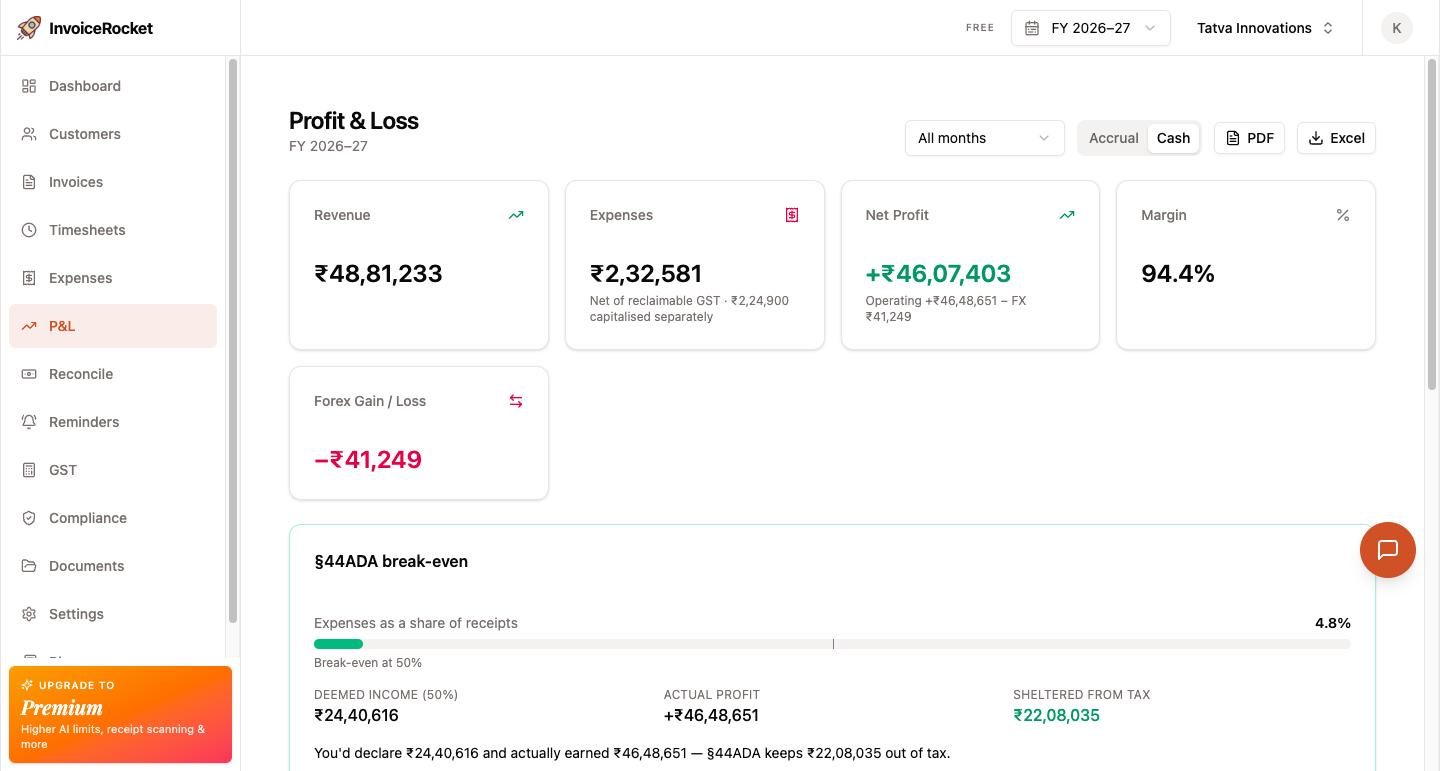
This is one of the reasons I built InvoiceRocket: when you mark a payment received, your year-to-date receipts update in INR, and it warns you when you cross ₹65 lakh so you have a quarter to decide, not a weekend. It also knows which structure you are (a proprietorship or partnership can be on 44ADA; an LLP or company cannot) and shapes your advance-tax reminders to match. If you do set up a second entity, you can run it as a separate organisation in the same account, with its own invoices, GSTIN and LUT. It is free for most freelancers. A spreadsheet works too, as long as you actually look at it in September.
For a quick what-if on your own numbers, the freelancer tax planner estimates the 44ADA versus regular bill and the advance-tax instalments for a given level of receipts, with no signup.
How this fits with the rest of your compliance
Changing structure touches the income-tax side, and drags the GST side along with it:
| Piece | When | What it covers |
|---|---|---|
| Section 44ADA basics | Annual, July | The 50% scheme this post assumes you already use. Guide. |
| Crossing ₹75 lakh | The year it happens | Books, audit, ITR-3, and the structures above |
| LUT | Annual, April, per GSTIN | Every new entity needs its own. Guide. |
| GSTR-1 / GSTR-3B | Monthly or quarterly, per GSTIN | Doubles when you add an entity. Guide. |
| TDS under 194J | Every Indian client payment | Firm or company gets the same 10% deducted; refunds work the same way. Guide. |
| Schedule FA | Annual, with the ITR | Foreign accounts in the new entity's name are reportable too. Guide. |
Frequently asked questions
Is the ₹75 lakh limit on receipts or on profit?
Gross receipts, in INR, for the financial year. Profit is irrelevant to the limit. The ₹75 lakh figure (rather than ₹50 lakh) applies only if your cash receipts are 5% or less of the total, which is automatic for anyone paid by bank transfer, Wise, Payoneer or PayPal. The general view is that GST you collect and pass on is not part of receipts, though if you export under an LUT there is no GST on your invoices anyway.
If I cross ₹75 lakh this year, can I go back to 44ADA next year?
Yes. The five-year lock-out after opting out of presumptive taxation applies to the business scheme under Section 44AD, not to 44ADA. If next year's receipts are at or below ₹75 lakh, you file ITR-4 on the presumptive basis again.
Can an LLP use Section 44ADA?
No. Section 44ADA covers resident individuals and partnership firms, and expressly excludes LLPs. Section 58 of the Income-tax Act, 2025 keeps the same exclusion. An LLP always pays 30% plus cess on actual profit with full books.
Does a partnership firm get its own ₹75 lakh limit?
Yes. A firm is a separate assessee with its own PAN and its own return, and Section 44ADA applies to it independently. The limit is tested against the firm's receipts, not the partners' combined receipts. Whether the department accepts the firm as genuine is a separate question of substance.
Can I split one client's contract between me and my firm to stay under the limit?
You can, and you should not. Alternating invoices on a single engagement to keep two assessees under ₹75 lakh is the textbook example of a colourable device; an assessing officer can look through the firm and add its receipts to yours, leaving you above the limit with no books, no audit, and penalties. A separate entity is defensible when it has separate clients or engagements, a real partner, its own bank account and GSTIN, and bears its own costs.
Is the dividend I pay myself from my own private limited taxed again?
Yes. The company pays 25.17% on its profit, and the dividend you take out of what is left is taxed in your hands at slab rates, with 10% TDS above ₹10,000 a year. Buybacks are treated as dividend as well, and a loan from the company to a 10%-plus shareholder is a deemed dividend. Salary is the only route out of a company that is taxed once. A partnership firm's profit share, by contrast, is exempt in the partner's hands under Section 10(2A).
Is moving to Dubai worth it for a freelancer at ₹1.2 crore?
Only if you are solo and expect to stay above ₹1 crore for years. The tax saved is about ₹33 lakh against a partnership firm, but Dubai rent and a licence cost a single person ₹18 to 25 lakh more than India, and a family with two children in school ₹40 to 55 lakh more, which wipes out the saving. You must also spend under 182 days a year in India, keep India-sourced income under ₹15 lakh, and genuinely work from the UAE. Above ₹2 crore the saving exceeds ₹60 lakh a year and the move pays for itself even with a family.
Do I need a tax audit once I am above ₹75 lakh?
Yes. For professions, the Section 44AB threshold is ₹50 lakh of gross receipts; 44ADA carved you out of it, and leaving 44ADA puts you back in. A CA files Form 3CB-3CD by 30 September and you file ITR-3 by 31 October. Firms, LLPs and companies at these receipt levels need the tax audit too, and LLPs and companies need a statutory audit on top.
What happens if I cross the limit in February or March?
The whole financial year switches to normal provisions, back to 1 April. You need books for the full year and a tax audit, and because 44ADA allowed a single advance-tax instalment on 15 March while normal provisions required four, you owe interest under Section 234C on the June, September and December instalments you did not pay. If you are anywhere near the line in a year, keep books from day one and pay advance tax quarterly as if you were going to cross.